I've spent the last few posts talking all about the history of American Comics and I hope all twelve of you reading enjoyed that, because now we're going to move from the world of facts to a place that I've slowly been moving things towards since the last update all about art in the 90s.
Time for some wild speculation that will all be proven wrong in just a few years!
Now, the comics industry is in a very odd place right now, a great deal of which is due to the world of digital comics. Webcomics exploded years ago and the market is so over saturated that, while there is a great deal of good out there, it's hard to sift through it all to find that. And really, there is a ton of gold out there to be found, but I'll talk more about that another time. Right now, though, digital comics on the iPad and other similar devices is what the industry is grappling with.
In many ways, it's a fight similar to the battle that books are having with e-readers, just on a smaller scale. The two major players in the industry, Marvel and DC, both have their own apps within which one can download comics at a price that is usually comparable to the same price of print comics, but until very recently, one could only get older comics, nothing brand new, digitally. Though this has changed, the problem of pricing remains and highlights the major problem that both Marvel and DC run into with digital: the fear to be the first to dive in head first.
Some would say that, with DC's recent relaunch of their entire line of comics, they've taken this dive already. And yes, DC has made some good steps, with Marvel doing much the same. Both now make all, in the case of DC, and nearly all, Marvel, of their comics available digitally every Wednesday, the day new comics are released in old fashioned, brick and mortar stores. But the prices, as mentioned, are horrid. $2-$4 for a digital copy of a roughly twenty page comic? That just won't work. Not for long, at least.
Digital is going to grow, one way or another, and it's vital for their survival that both Marvel and DC figure out how to do things reasonably. Partial stories delivered monthly like serials of old, the current model of the industry, is a dangerous gamble when combined with the instant gratification that digital creates. Is the cost worth the time to read and then the time to wait for the next issue? At the moment, no, so two obvious things definitely need to happen, though when and if they actually do is questionable.
First, page counts for digital comics need to go up. Someway, somehow, the publishers have got to find a way to release larger books digitally. The idea of digital trades, collections of finished stories that put all the single issues together, is already out there and being done, and the pricing is a bit better, but it still isn't enough. If one is expected to pay $4 for a digital comic, at least double the size of the book. 40 pages for that price begins to feel more reasonable, and even more so at $2. Yes, it's low, but that's how digital works. The music world has gone through this with iTunes and you'd be hard pressed to find many people that are willing to pay more than $0.99 for a single song. A comic needs to be as near that price point as possible.
But this is more an issue for the Now than the Future, so I'll stop going in circles and try to look ahead here.
So yes, I have no doubts that digital is the future, at least in some form. And I also believe that, like books, the physical comics will never truly disappear, though they may become a smaller and smaller piece of the market on the whole. There will always be a group that want the physical things, the music world is, again, a good example of this.
Stories will likely find a middle ground between the current trend of heavily serialized, overarching story lines and the classic so-called "one and done" story, which is more self contained, obviously. In some ways, this is a fight of style that will never truly go away, but the last few decades stories seem to have shifted dramatically from one side to the other, with the industry more strongly on the side of heavy serialization right now. But these things tend to balance out over time, and both types have merit. I'm fairly sure the industry needs to do both, instead of one or the other, if only to bring in more readers who prefer different types of storytelling. You'd be amazed, or perhaps not at all, but how many fans have left comics in the last decade because they feel they can no longer pick up any single issue and enjoy it on its own.
Beyond this, I do think webcomics will mature on the whole. I'd like to believe that we can move away from all webcomics needing to be joke-a-day style comics and push into more serious topics and genres. The content delivery of the internet shouldn't restrict the genre and the main reason for the current over saturation is that 90% of webcomics really are just the same joke style comics as everything else...and not funny. There have always been a small number of more serious, traditional-styled comics and stories in the webcomic world, and I'm glad to see more and more appearing in the last couple of years. If these kinds of webcomics are allowed to grow, it will only do good and, at the very least, allow more people the chance to tell stories and possibly even get noticed by the industry at large.
There is one major danger in looking forward, though, and that is nostalgia. In many ways, American comics are built on nostalgia, and to a point that's okay. But if the industry gets caught up in only catering to the group that wants to relive their childhood through comics, things will not continue for long. New is vital. And new can be done with old things. Some of the best stories with classic characters have been told in recent years, and I have no doubt that even better stories lie ahead, but none of that can happen if the industry allows itself to grow smaller and smaller without reaching out beyond its current audience.
In many ways, that's why I made this blog and write all of these long winded ramblings about why I love comics and feel they're a legitimate art form. There is something here for everyone, but that still requires the publishers to put it out there FOR everyone.
Okay, well, it looks like I had less to speculate about than I'd thought. Still, there are a couple of similar topics to this I want to talk about all on their own. So as the days go by, I'll have another artist-specific post finally go up, tackle webcomics in a much more focused way, and probably finally get around to talking about this DC relaunch and what it means...since this Wednesday marks the last of their new books and it'll be a perfect time to look at how this can be a good or bad thing for the industry, both artistically and overall viability.
Oh, and one last thing. My last post I horribly disparaged the long-running, never ending Spider-Man story, The Clone Saga. I want to remedy that cruelness. Yes, it continued to almost end and then go on, and when it finally did end, no one was happy and it was a convoluted mess, but I will say one very good things came out of it that probably shows, more than anything, my age. Spider-Man's clone, Ben Reilly, is a great character and one that deserves a return. So there, the Clone Saga wasn't all bad. Just...mostly bad.

Showing posts with label audience. Show all posts
Showing posts with label audience. Show all posts
Wednesday, September 28, 2011
Monday, September 26, 2011
A Look at Comics History: Art in the Modern Age
Okay. Here we are. This subject is the first of two that started my desire to run through comics history as I' done in the last week. Before I dive into the meat of this, though, I feel it's important to preface what I say. As I've mentioned before, I want to stay positive on this blog. This all comes about through a love of art and comics, especially when they come together. Sometimes, though, we have to look at failings and identify just what went wrong so as to know how to avoid those problems in the future, for the good of the medium. This is going to get into some fairly negative things and strong criticism on the artistic end of things, and I feel that is necessary and important.
But, and this is a big one, any and all critiques are about the art, NOT the artists. I hate that I feel the need to state that, but it's vital and my years of art school taught me that all of us, myself included, can have trouble separating art from artist when it comes to criticism. Good people make bad art and bad people make good art. That's life, and I'm not here to judge people, only to talk about art.
This leads into one other important bit that many people, artists and non-artists alike, have trouble accepting: While art is subjective, all art contains objective elements that make them up. There are objective qualities with which we can judge all works of art, simple things like use of line, shape, and perspective, etc. Now, this does not discount someone from LIKING a piece of art or a style that fails on those levels. Everyone has a different taste, and that's perfectly fine. I'm not out to judge taste, and I want to make sure that is as understood as the last point.
 On that note, I want to put in a bit of honesty to back up the point. Jack Kirby is the king of comic book art. American comics owe everything to him, both stylistically and in the way stories are told. Everything about how he handled the technical aspects of art are damn near perfect and he knew exactly how to lead the eye across the page without error...not to mention the man had one of the greatest imaginations ever. But, for years and years, I looked at early comic art, especially Kirby's, and could not understand why it was good. It looks blocky, formless, and just primitive to my younger, untrained eye. After a few years of college, both making art and studying the masters of history, and I came back to see Kirby's art was shockingly greater than I had ever dreamed. Before this, I couldn't understand how composition truly worked, why he deconstructed forms in the way he did, or why I should care about the art when compared to modern art that was, on the surface, prettier and flashier, but not nearly as effective 90% of the time. I've heard this same story from many other young guys that are interested in comics, and I think it goes to show how much deeper art can be beyond simply whether you like something or not. There are fundamental reasons why some art works better than others, and understanding those can really open a person's eyes.
So. Comic art. Before I can dive into modern art, I have to, yet again, hit a couple things to back it all up and give it some grounding. Though I briefly ran through the different era's of comics through the past century, I didn't really focus on art styles and how they changed too much, but it's important to understand that a great deal has happened to art in comics through the years. Styles have evolved and changed to the point that, today, we have a mix of wonderful retro styles that emulate the best of the Golden Age creators, crazy stylized art that looks like almost nothing else, hyper-realistic art that most people never imagine could be in comics, and, of course, everything in between. Comic are is shockingly diverse today, and everyone is the better for it. But some things have been left behind because they were bad or just not as effective. That's how a medium evolves.
Artistically, the Modern Age of Comics started out very similar to the Bronze Age. George Perez's art on Crisis on Infinite Earths wasn't altogether different than what had come before. This isn't to say it was bad, as the style is wonderfully effective at telling stories, but Perez's art is much more what could be classified as 'traditional' comic art. One of the biggest breaks from this style to something more unique was thanks to Frank Miller in the previously mentioned Batman: The Dark Knight Returns. Miller's art is heavy, filled with blacks and thick lines that help the mood of the book wonderfully. There's really nothing pretty about his work, with everything purely dark and hardened. It's exactly what the book needed. But Miller's style is very much his own, and though some have emulated him, it hasn't ever really caught on as a style.
Which leads right into a style that did catch on. As I talked about last time, the early 90s saw the rise of literal superstar artists: Jim Lee, Tod McFarlane, Rob Liefeld, Erik Larson, and Marc Silvestri are the ones I see as the main guys to look at for defining the art, and, interestingly enough, all were founding members of Image Comics. This is, of course, just a small list and I'm likely to only talk about the first three, but the interesting thing is that all of these artists shared many similarities in style.
In some ways, it's hard to define what exactly makes the art of the 90s so different. Usually, it's easy to identify the second it's seen, but describing a trend is harder to do, so apologies if this comes out as nonsense. On the whole, though, the art sharpened. Literally sharpened. Lines tended to all come to points, and everything was given a sharp feel, on the whole, from everything to how forms were put together to lines used to shade an object and give it depth. The art of the 90s is heavily focused on line, almost to the exclusion of all other elements. It has the effect of making all of the art much more aggressive, and this fit the tone of the stories of the time fairly well.
 This isn't an inherently bad thing for art, but it is distinct. I grew up on Jim Lee art, and though my tastes have shifted, his X-Men will always be my X-Men when I first think of them. While that's definitely nostalgia talking, to a point, I do think that Jim Lee is one of the best and defining artists comics has ever had. To me, this image here is the quintessential Jim Lee for me, and I expect many, many others. You can see the heavy, distinct use of line here without having to look hard. But this heavy focus on line starts to break down when it comes to the construction of form. It's a pretty heavy trait of 90s art that the men are huge and muscled while the women have tiny, tiny waists and giant chests, and most of that can be seen here, though not to an insane degree. The real problem here that really sticks out at me and is a pretty serious trouble in comics these days, still, is the way the women pose. None of that, save for maybe Storm's flying forward, looks at all comfortable or natural. There's a feel of posing for the reader, and that's a trouble comics still struggle with greatly, especially with regards to female characters.
 In many ways, Todd McFarlane's art of the time is similar and there isn't too much different to be said. Instead, I really want to use his art to focus on another thing that became a big deal in the comic art of the time. The extreme use of line had a habit of just getting out of hand. Lines are just everywhere, and in some ways it feels like an indecipherable mess. There are many images where I feel bad for the colorists trying to determine what is what, as the glut of lines just leads to confusion. What's odd is that this became a way to tell if an artist was 'good'. For some reason, the idea seemed to be that, the more lines one used, the more detailed and stronger an artist was. The idea of implied line was lost and any subtlety was gone in an instant. The real beauty of much of the older comic art, especially Jack Kirby's, is subtlety and expert use of line...and where not to use line. The art of simplicity just disappeared entirely with the superstars of the 90s, and this harmed the medium greatly.
So now we get to a name I expect many reading this that know comics have been waiting for: Rob Liefeld. He is equally reviled and adored in comics today, and there are enough people out there tastelessly bashing the guy for his art. I'm not here to do that. And no, I'm not a fan of Liefeld's art, but that doesn't require me to come across as a complete asshole in the hopes of getting hits here. It is actually possible to discuss art one doesn't like in calm, intelligent terms without being a complete jerk, and that's my goal. So...
 Liefeld's art essentially takes the stereotypes of how we seen 90s art, huge men and tiny women, etc, and expands on them ten fold. One can go on an on about those subjects, and others already have and, if you want to read them, you can find them pretty easily with a google search. All the points that I could really make about his art I've made in my generalizations already, just that he really took them in his art and pushed them further. So why not take a different direction and look at WHY these seemed to work, when on almost any artistic level, they're just bad?
I think it works and sold for some simple reasons that I hit on last post. In the 90s, comics became all about flash and no substance. It was all about ultra-violence, blood, guts, swords, big guns, and insane plots that really were just excuses to have cool, dramatic splash pages. Liefeld's art is all of this. The quality of the line work, the way the shapes just fail to actually look like what they should, and the problems with perspective that are there didn't actually matter to the readers of the time because Liefeld's art had what they wanted more: Violence, action, and guns. What does it matter if a figure doesn't have feet if, right there on the page, a guy's head is being chopped off? But that's the real problem. Art takes work, even comic art, and somehow, the industry was caught in a phase where the quality really stopped mattering and the content, as ridiculous as it was, really dominated. As much as some people look to the comics of the Golden Age and Silver Age as 'bad art', this is untrue and an uninformed opinion, whereas the art of the 90s really, as a whole, did active harm to the industry and the medium while really holding no value of its own.
Essentially, I think Liefeld's art tends to epitomize what went wrong with comics in the 90s, though it wasn't WHY things went wrong. That confluence of troubles I've already talked about, and the art is only a single part of that. To blame all of it on Liefeld or any artist in particular is stupid, when the companies themselves were happily releasing these books, speculators were eating them up, and so were fans...creating even more demand until it all just tanked and nearly destroyed everything. The fault is on everyone, but that doesn't mean we can't learn, and I think the medium has.
In all honesty, I think it's pretty clear that I'm not a fan of the 90s and comics. This was my first introduction to the medium and I didn't stay for long thanks to the art, and looking back I find that, unlike with other eras, I still don't find much with any merit. I could a great deal more negative than I have been, and maybe even more positive, but the former leads to coming across like a jerk and the latter would mostly be untrue. I've tried to at least be as objective as possible here, and if that makes it feel like I've just skipped over large topics to hit on here, well...I do apologize but it's likely I can't say much without devolving into angry ranting and...well, the internet has enough of that.
As I've said, if you look at comic art now, there is a diversity of styles that is unequaled in the past. It's almost as if all the years were building up to a huge artistic and sales crash in the 90s, just so we could come out of it, as a medium, wanting something more. Today, guys like Jim Lee and Rob Liefeld are still working, and that's great because they have fans that want exactly what they do. But the world of comic art is no longer dominated by just one style. Now there are men and women like Chris Samnee, Skottie Young, Amanda Conner, Marcos Martin, Sara Pichelli, Emma Rios, John Romita Jr., David Aja, Francis Manapul, and countless others out there creating art, all in a variety of styles that cover so many angles that there really is an art style for everyone.
So maybe we needed the insanity of art in the 90s. Maybe that homogenization of sharp, odd art that didn't really succeed at anything beyond being flashy and in-one's-face was the kind of wake-up call to artists and readers that diversity is good. So hey, maybe the 90s weren't all that bad.
Not that I suggest you go read Spider-Man's Clone Saga. Whew, that's still a mess.
But, and this is a big one, any and all critiques are about the art, NOT the artists. I hate that I feel the need to state that, but it's vital and my years of art school taught me that all of us, myself included, can have trouble separating art from artist when it comes to criticism. Good people make bad art and bad people make good art. That's life, and I'm not here to judge people, only to talk about art.
This leads into one other important bit that many people, artists and non-artists alike, have trouble accepting: While art is subjective, all art contains objective elements that make them up. There are objective qualities with which we can judge all works of art, simple things like use of line, shape, and perspective, etc. Now, this does not discount someone from LIKING a piece of art or a style that fails on those levels. Everyone has a different taste, and that's perfectly fine. I'm not out to judge taste, and I want to make sure that is as understood as the last point.
 On that note, I want to put in a bit of honesty to back up the point. Jack Kirby is the king of comic book art. American comics owe everything to him, both stylistically and in the way stories are told. Everything about how he handled the technical aspects of art are damn near perfect and he knew exactly how to lead the eye across the page without error...not to mention the man had one of the greatest imaginations ever. But, for years and years, I looked at early comic art, especially Kirby's, and could not understand why it was good. It looks blocky, formless, and just primitive to my younger, untrained eye. After a few years of college, both making art and studying the masters of history, and I came back to see Kirby's art was shockingly greater than I had ever dreamed. Before this, I couldn't understand how composition truly worked, why he deconstructed forms in the way he did, or why I should care about the art when compared to modern art that was, on the surface, prettier and flashier, but not nearly as effective 90% of the time. I've heard this same story from many other young guys that are interested in comics, and I think it goes to show how much deeper art can be beyond simply whether you like something or not. There are fundamental reasons why some art works better than others, and understanding those can really open a person's eyes.
So. Comic art. Before I can dive into modern art, I have to, yet again, hit a couple things to back it all up and give it some grounding. Though I briefly ran through the different era's of comics through the past century, I didn't really focus on art styles and how they changed too much, but it's important to understand that a great deal has happened to art in comics through the years. Styles have evolved and changed to the point that, today, we have a mix of wonderful retro styles that emulate the best of the Golden Age creators, crazy stylized art that looks like almost nothing else, hyper-realistic art that most people never imagine could be in comics, and, of course, everything in between. Comic are is shockingly diverse today, and everyone is the better for it. But some things have been left behind because they were bad or just not as effective. That's how a medium evolves.
Artistically, the Modern Age of Comics started out very similar to the Bronze Age. George Perez's art on Crisis on Infinite Earths wasn't altogether different than what had come before. This isn't to say it was bad, as the style is wonderfully effective at telling stories, but Perez's art is much more what could be classified as 'traditional' comic art. One of the biggest breaks from this style to something more unique was thanks to Frank Miller in the previously mentioned Batman: The Dark Knight Returns. Miller's art is heavy, filled with blacks and thick lines that help the mood of the book wonderfully. There's really nothing pretty about his work, with everything purely dark and hardened. It's exactly what the book needed. But Miller's style is very much his own, and though some have emulated him, it hasn't ever really caught on as a style.
Which leads right into a style that did catch on. As I talked about last time, the early 90s saw the rise of literal superstar artists: Jim Lee, Tod McFarlane, Rob Liefeld, Erik Larson, and Marc Silvestri are the ones I see as the main guys to look at for defining the art, and, interestingly enough, all were founding members of Image Comics. This is, of course, just a small list and I'm likely to only talk about the first three, but the interesting thing is that all of these artists shared many similarities in style.
In some ways, it's hard to define what exactly makes the art of the 90s so different. Usually, it's easy to identify the second it's seen, but describing a trend is harder to do, so apologies if this comes out as nonsense. On the whole, though, the art sharpened. Literally sharpened. Lines tended to all come to points, and everything was given a sharp feel, on the whole, from everything to how forms were put together to lines used to shade an object and give it depth. The art of the 90s is heavily focused on line, almost to the exclusion of all other elements. It has the effect of making all of the art much more aggressive, and this fit the tone of the stories of the time fairly well.

 In many ways, Todd McFarlane's art of the time is similar and there isn't too much different to be said. Instead, I really want to use his art to focus on another thing that became a big deal in the comic art of the time. The extreme use of line had a habit of just getting out of hand. Lines are just everywhere, and in some ways it feels like an indecipherable mess. There are many images where I feel bad for the colorists trying to determine what is what, as the glut of lines just leads to confusion. What's odd is that this became a way to tell if an artist was 'good'. For some reason, the idea seemed to be that, the more lines one used, the more detailed and stronger an artist was. The idea of implied line was lost and any subtlety was gone in an instant. The real beauty of much of the older comic art, especially Jack Kirby's, is subtlety and expert use of line...and where not to use line. The art of simplicity just disappeared entirely with the superstars of the 90s, and this harmed the medium greatly.
So now we get to a name I expect many reading this that know comics have been waiting for: Rob Liefeld. He is equally reviled and adored in comics today, and there are enough people out there tastelessly bashing the guy for his art. I'm not here to do that. And no, I'm not a fan of Liefeld's art, but that doesn't require me to come across as a complete asshole in the hopes of getting hits here. It is actually possible to discuss art one doesn't like in calm, intelligent terms without being a complete jerk, and that's my goal. So...

I think it works and sold for some simple reasons that I hit on last post. In the 90s, comics became all about flash and no substance. It was all about ultra-violence, blood, guts, swords, big guns, and insane plots that really were just excuses to have cool, dramatic splash pages. Liefeld's art is all of this. The quality of the line work, the way the shapes just fail to actually look like what they should, and the problems with perspective that are there didn't actually matter to the readers of the time because Liefeld's art had what they wanted more: Violence, action, and guns. What does it matter if a figure doesn't have feet if, right there on the page, a guy's head is being chopped off? But that's the real problem. Art takes work, even comic art, and somehow, the industry was caught in a phase where the quality really stopped mattering and the content, as ridiculous as it was, really dominated. As much as some people look to the comics of the Golden Age and Silver Age as 'bad art', this is untrue and an uninformed opinion, whereas the art of the 90s really, as a whole, did active harm to the industry and the medium while really holding no value of its own.
Essentially, I think Liefeld's art tends to epitomize what went wrong with comics in the 90s, though it wasn't WHY things went wrong. That confluence of troubles I've already talked about, and the art is only a single part of that. To blame all of it on Liefeld or any artist in particular is stupid, when the companies themselves were happily releasing these books, speculators were eating them up, and so were fans...creating even more demand until it all just tanked and nearly destroyed everything. The fault is on everyone, but that doesn't mean we can't learn, and I think the medium has.
In all honesty, I think it's pretty clear that I'm not a fan of the 90s and comics. This was my first introduction to the medium and I didn't stay for long thanks to the art, and looking back I find that, unlike with other eras, I still don't find much with any merit. I could a great deal more negative than I have been, and maybe even more positive, but the former leads to coming across like a jerk and the latter would mostly be untrue. I've tried to at least be as objective as possible here, and if that makes it feel like I've just skipped over large topics to hit on here, well...I do apologize but it's likely I can't say much without devolving into angry ranting and...well, the internet has enough of that.
As I've said, if you look at comic art now, there is a diversity of styles that is unequaled in the past. It's almost as if all the years were building up to a huge artistic and sales crash in the 90s, just so we could come out of it, as a medium, wanting something more. Today, guys like Jim Lee and Rob Liefeld are still working, and that's great because they have fans that want exactly what they do. But the world of comic art is no longer dominated by just one style. Now there are men and women like Chris Samnee, Skottie Young, Amanda Conner, Marcos Martin, Sara Pichelli, Emma Rios, John Romita Jr., David Aja, Francis Manapul, and countless others out there creating art, all in a variety of styles that cover so many angles that there really is an art style for everyone.
So maybe we needed the insanity of art in the 90s. Maybe that homogenization of sharp, odd art that didn't really succeed at anything beyond being flashy and in-one's-face was the kind of wake-up call to artists and readers that diversity is good. So hey, maybe the 90s weren't all that bad.
Not that I suggest you go read Spider-Man's Clone Saga. Whew, that's still a mess.

Tuesday, September 6, 2011
The Superhero Genre
When the word 'comics' comes up, in many cases, its shorthand for 'superhero comics'. Comics are, as I've addressed a few times and is fairly easy to see looking beyond the surface, a medium and not a genre, but that's neither here nor there. In many ways, American comics ARE superheroes. There are a multitude of reasons for this, but one of the main ones being that, as comics struggled through the 50s and 60s, almost all the other genres that were popular at the time (romance, horror, scifi comics, etc) just didn't survive while superhero books did. A complicated history led to all of this, but right now I want to focus on the genre itself rather than the why.
But before going further, a clarification is important to make here. Superheroes are a genre, yes, but not as specific as something like science fiction. The superhero genre really is a larger, overarching idea that can and does encompass practically any genre one could want. There's science fiction (Fantastic Four, Green Lantern), horror (Hellboy, Ghost Rider), crime/noir (Batman), and various others depending on exactly how you want to nail things down. But while the specifics can alter based on these sub-genres of the superhero idea, the base is there.
And really, the idea of a superhero is pretty simple. So simple that most everyone understands the concept and the genre itself without needing any explanation. Yet superheroes are generally considered childish fantasies or something only for a fringe group of older fans of the characters. This is so extreme that it goes to the point where superheroes alone are the main reason why many people never give comics a chance as a medium, thinking its all ridiculous stories about people fighting crime while wearing tights. Its hard to fault this point of view, but it brings me to a thought that has been on my mind for a while now that I wanted to address.
It has been said many times by people much smarter than I that Superman, Spider-Man, and all the other heroes are the modern equivalents of the classic mythical heroes like Hercules and Perseus. That singular, powerful hero with abilities beyond the normal human, be it in intelligence or actual powers, who comes to save the day for the mortals. While the dressings are different, the core is the same. These classic stories aren't just for kids or some select group, and neither should superheroes. Sure, kids SHOULD have comics for them, and that's a problem all in its own, but the very idea isn't exclusively limited to an age group.
In fact, there is another modern equivalence to all of this that really only removes the tights from the equation: the action hero. Die Hard, Rambo, Predator, the James Bond movies, the Indiana Jones movies, and countless more present characters that are, essentially, superheroes. They are idealized humans in various ways that, in almost all cases, at the very least have the power to take insane punishments and keep fighting. Strip away many of the dressings and here, again, we have mythical heroes of a modern time.
All of these characters, from Hercules to Spider-Man to James Bond, are ingrained in our culture at a very deep level. But if there is so much similarity here, is it really something as simple as tights and powers that hold superheroes back still?
Maybe.
But then again, maybe not.
All of these archetypes of heroes have their own specific uniforms, just some are more innocuous than others. James Bond has his tuxedo and gadgets, Indiana Jones his fedora and bullwhip, Perseus has his polished shield and helm of darkness, and Batman his tights and utility belt. Signature identifying pieces of all these characters and they all tend to share a great deal with one another. But these days, we tend to accept the action hero with normal clothes and a gun, with the amazing power to never be shot unless its dramatically appropriate, over someone with bulletproof skin, saying that the latter is somehow more of a childish fantasy.
It isn't, of course. They're both equally ridiculous, and that's really what I've been working my way around constantly here. Not only that, but it isn't necessarily something that will always remain so. Trends and cultural ideas have a habit of changing, and the rise of superheroes in movies seems to be pushing them into a more accepted cultural place. Obviously, I think this is a very good thing. There is much more to many superheroes than the fact that they just punch bad guys, a strong contrast to most modern action heroes that...well, just shoot bad guys.
The real hope I have behind all of this, which I think is the hope of most any sane person that enjoys superheroes, is that the rise of superhero movies does help turn more to the comics. There is something for everyone in the medium, kids and adults alike, and even if a person swears they hate superheroes...there's a chance they might just not have found the right one yet.
But before going further, a clarification is important to make here. Superheroes are a genre, yes, but not as specific as something like science fiction. The superhero genre really is a larger, overarching idea that can and does encompass practically any genre one could want. There's science fiction (Fantastic Four, Green Lantern), horror (Hellboy, Ghost Rider), crime/noir (Batman), and various others depending on exactly how you want to nail things down. But while the specifics can alter based on these sub-genres of the superhero idea, the base is there.
And really, the idea of a superhero is pretty simple. So simple that most everyone understands the concept and the genre itself without needing any explanation. Yet superheroes are generally considered childish fantasies or something only for a fringe group of older fans of the characters. This is so extreme that it goes to the point where superheroes alone are the main reason why many people never give comics a chance as a medium, thinking its all ridiculous stories about people fighting crime while wearing tights. Its hard to fault this point of view, but it brings me to a thought that has been on my mind for a while now that I wanted to address.
It has been said many times by people much smarter than I that Superman, Spider-Man, and all the other heroes are the modern equivalents of the classic mythical heroes like Hercules and Perseus. That singular, powerful hero with abilities beyond the normal human, be it in intelligence or actual powers, who comes to save the day for the mortals. While the dressings are different, the core is the same. These classic stories aren't just for kids or some select group, and neither should superheroes. Sure, kids SHOULD have comics for them, and that's a problem all in its own, but the very idea isn't exclusively limited to an age group.
In fact, there is another modern equivalence to all of this that really only removes the tights from the equation: the action hero. Die Hard, Rambo, Predator, the James Bond movies, the Indiana Jones movies, and countless more present characters that are, essentially, superheroes. They are idealized humans in various ways that, in almost all cases, at the very least have the power to take insane punishments and keep fighting. Strip away many of the dressings and here, again, we have mythical heroes of a modern time.
All of these characters, from Hercules to Spider-Man to James Bond, are ingrained in our culture at a very deep level. But if there is so much similarity here, is it really something as simple as tights and powers that hold superheroes back still?
Maybe.
But then again, maybe not.
All of these archetypes of heroes have their own specific uniforms, just some are more innocuous than others. James Bond has his tuxedo and gadgets, Indiana Jones his fedora and bullwhip, Perseus has his polished shield and helm of darkness, and Batman his tights and utility belt. Signature identifying pieces of all these characters and they all tend to share a great deal with one another. But these days, we tend to accept the action hero with normal clothes and a gun, with the amazing power to never be shot unless its dramatically appropriate, over someone with bulletproof skin, saying that the latter is somehow more of a childish fantasy.
It isn't, of course. They're both equally ridiculous, and that's really what I've been working my way around constantly here. Not only that, but it isn't necessarily something that will always remain so. Trends and cultural ideas have a habit of changing, and the rise of superheroes in movies seems to be pushing them into a more accepted cultural place. Obviously, I think this is a very good thing. There is much more to many superheroes than the fact that they just punch bad guys, a strong contrast to most modern action heroes that...well, just shoot bad guys.
The real hope I have behind all of this, which I think is the hope of most any sane person that enjoys superheroes, is that the rise of superhero movies does help turn more to the comics. There is something for everyone in the medium, kids and adults alike, and even if a person swears they hate superheroes...there's a chance they might just not have found the right one yet.
Sunday, September 4, 2011
A Few Thoughts on My Artist Posts
Okay, this is going to be a bit short. I've been having some trouble writing more Artists You Should Know, and instead of staring at a blank page about it, I figured I'd tackle it head on and make a post all about that problem.
The goal of all of those posts is, of course, to widen the notice of very good artists and storytellers to an audience that may not know they exist and may think of comics as just a bunch of crude drawings to tell jokes. Now, as I've said over and over, my real goal is to present these people to other artists in the fine art world and the art education world: professors, students, etc. I know at least a few read the blog, so its working some, I hope, but I'm trying to find ways to really push these to people like art professors more without being annoying. Sure, comic fans may already have an awareness of these artists, and that's great, but what about those young art students that are just learning art history? Don't they deserve to learn about comic masters and modern comic artists as much as the fine art world?
I'm purposefully focusing on more modern, working artists for these posts. This is mainly due to the fact that there are already tons of resources for information and validation of guys like Jack Kirby and and Will Eisner. The masters that made comics what they are today and really defined a style and way of telling stories sequentially are well dealt with in other places. But working artists now? Not really so much, so I figure I could say a few things and get some eyes on people.
Which comes to the real stumbling block with the artist pieces I do here: picking an artist. There are so, so many current artists that deserve attention. Oddly enough, this large amount of people I want to talk about, even removing the greats of the past, is still enough to cause me to be unsure of who to talk about next.
So as a bit of a tease, here are the people on my not-so-short list for the future: Paolo Rivera, Sara Pichelli, David Aja, Dustin Weaver, Stuart Immonen, Jock, Alex Maleev, Stefano Caselli, Humberto Ramos, Marcos Martin, Olivier Coipel, Mark Morales, Laura Martin, Francis Manapul, Salvador Larocca, Frank Quitely, and a ton of others. They'll come in no particular order and that's the tough part, but they'll come.
The key point I keep harping on is the true struggle, though. These men and women are artists that are ignored by a large section of the art world that teach new artists. If comics get a mention at all, its usually much more 'indie' creators that tend to be something closer to post-modern artists and that opens a whole different can of worms. I am, clearly, a firm believer that more 'traditional' comic artists deserve just as much recognition in an art history course covering modern times as any fine artist, and that's why I keep hitting these points over and over.
Superhero comics are a truly American art form. They aren't kitsch, and the artists that work on them do not deserve to be brushed aside as they are continuing a tradition of American art that has gone unnoticed only because of how easily available it is to the masses. And beyond even that is the other point I'll never let go of: The ability to tell a story in series of static images is in no way easy, and it is a skill that can help nearly any artist.
So there's a slight rant from me, mostly on the mild side. In many ways, I wish I had been this strongly dedicated to these ideas when I was in college, but better late than never! And, hey, if you have any desire to see my own attempts at making comics, with, of course, my wonderful wife, check out our art blog as we finally start growing it. Yes, that's the second shameless plug, but I'm allowed that!
Don't worry, next post will be either one of the artist talks or another more heady, philosophical talk! I shall cease this rambling mess for now! Enjoy the holiday weekend.
The goal of all of those posts is, of course, to widen the notice of very good artists and storytellers to an audience that may not know they exist and may think of comics as just a bunch of crude drawings to tell jokes. Now, as I've said over and over, my real goal is to present these people to other artists in the fine art world and the art education world: professors, students, etc. I know at least a few read the blog, so its working some, I hope, but I'm trying to find ways to really push these to people like art professors more without being annoying. Sure, comic fans may already have an awareness of these artists, and that's great, but what about those young art students that are just learning art history? Don't they deserve to learn about comic masters and modern comic artists as much as the fine art world?
I'm purposefully focusing on more modern, working artists for these posts. This is mainly due to the fact that there are already tons of resources for information and validation of guys like Jack Kirby and and Will Eisner. The masters that made comics what they are today and really defined a style and way of telling stories sequentially are well dealt with in other places. But working artists now? Not really so much, so I figure I could say a few things and get some eyes on people.
Which comes to the real stumbling block with the artist pieces I do here: picking an artist. There are so, so many current artists that deserve attention. Oddly enough, this large amount of people I want to talk about, even removing the greats of the past, is still enough to cause me to be unsure of who to talk about next.
So as a bit of a tease, here are the people on my not-so-short list for the future: Paolo Rivera, Sara Pichelli, David Aja, Dustin Weaver, Stuart Immonen, Jock, Alex Maleev, Stefano Caselli, Humberto Ramos, Marcos Martin, Olivier Coipel, Mark Morales, Laura Martin, Francis Manapul, Salvador Larocca, Frank Quitely, and a ton of others. They'll come in no particular order and that's the tough part, but they'll come.
The key point I keep harping on is the true struggle, though. These men and women are artists that are ignored by a large section of the art world that teach new artists. If comics get a mention at all, its usually much more 'indie' creators that tend to be something closer to post-modern artists and that opens a whole different can of worms. I am, clearly, a firm believer that more 'traditional' comic artists deserve just as much recognition in an art history course covering modern times as any fine artist, and that's why I keep hitting these points over and over.
Superhero comics are a truly American art form. They aren't kitsch, and the artists that work on them do not deserve to be brushed aside as they are continuing a tradition of American art that has gone unnoticed only because of how easily available it is to the masses. And beyond even that is the other point I'll never let go of: The ability to tell a story in series of static images is in no way easy, and it is a skill that can help nearly any artist.
So there's a slight rant from me, mostly on the mild side. In many ways, I wish I had been this strongly dedicated to these ideas when I was in college, but better late than never! And, hey, if you have any desire to see my own attempts at making comics, with, of course, my wonderful wife, check out our art blog as we finally start growing it. Yes, that's the second shameless plug, but I'm allowed that!
Don't worry, next post will be either one of the artist talks or another more heady, philosophical talk! I shall cease this rambling mess for now! Enjoy the holiday weekend.
Friday, August 12, 2011
Roy Lichtenstein: Plagiarist or Art Thief?
Okay. Before this gets going, two warnings. First: this is likely to be a very long entry. I may even divide it up into two posts. So get comfy. Second: This will, most likely, be my only negative talk about an artist. This is a topic that makes me very angry. In fact, my anger over this topic is part of the reason this blog exists in the first place. There is a distinct possibility I will be much less formal and devolve into angry ranting. I shall do my best to avoid this, but you've been warned. This is something I'm very passionate about.
So. Roy Lichtenstein. His art is loved by artists, teachers, critics, historians, and students alike. Everyone knows "his" work, and those quotes are there for a reason as can likely be inferred from the title of this post alone. Every single art history class mentions him in some form, be it at a high school or college level. He is supposedly a great master of Pop Art, one of the first, even. His taking of comic panels and turning them into larger paintings is still seen as a great use of "low art" and turning it into "high art."
To that, I give you a simple response that can sum up my entire feelings on this without any pretense.
Bull. Shit.
First, it must be made clear that my anger towards Lichtenstein is not because I'm some crazed lover of comics. Clearly, I love comics. Clearly, I believe comics should be treated as art and not some trash to be ignored. And guess what? Lichtenstein is the poster child for the problem. His copies of panels from master comic artists are insipid pieces that only have any life because of the original artists, not his work. Not to mention the fact that nearly all of his copies are inferior to the originals on basic levels, such as line quality, form, etc. And on top of THAT, his lettering is offensively bad all on its own. Oh, and on top of even that, there's the fact that he never credited the original artists, selling his copies for millions while the actual artists saw nothing of it and some spent their lives struggling to make it.
Now before I get into direct comparisons between his "art" and the original works, I want to shoot down the usual counters to these points I'm making. I've already hit on the fact that comics are not "low art" and that the artists behind the originals are worthy of far more praise than they ever have received from the art community, but just keep repeating that because its going in circles in my head.
The other major thing is the idea of Pop Art. One of the other major players in the Pop Art movement was Andy Warhol. Everyone knows his work to some degree. Soup cans, Marilyn Monroe, etc. He stole, too, and while I have a special hatred for some of his work for similar reasons, Lichtenstein was specifically stealing from OTHER artists at the time and essentially taking credit for their work, all the while letting the art world continue to belittle them. But on the idea of Pop Art, the twisting of popular culture into "art" and playing on ideas of mass production and similar themes, Lichtenstein's work STILL doesn't qualify as worthy of praise. Why? Because it is simple plagiarism, at best, and theft, at its worst. Many of the artist he copied were working at the time he was.
This is where the "but all artists steal" comment always comes in. And yes, in many ways, that's true. But that doesn't mean we should condone it, or dismiss the original artists as mere "drawers" as the Lichtenstein Foundation has. But you also have to remember that the only reason Lichtenstein is continued to be seen as such a great artist and thus, can get away with it even after his death, is because he has "historical significance." That's a pathetic way of saying that, yet again, he's better than the original artists despite the fact that doing what he did in any Art School worth its salt would have a student dismissed. You don't get to steal hundreds of pieces of art from other artists and call it your own, especially if you refuse to admit they existed or did anything of significance before you came along and did your thing. That's just called being an asshole.
So suck it up and accept the truth. Lichtenstein was a hack that couldn't paint well even when he copied, and now's the part where I start posting images to show that.
But yet again, one more thing crops up that I must mention. The images I'll be using are from an man named David Barsalou, who's been working for over three decades to find the original sources of many of Lichtenstein's paintings. He has an amazing Flickr page with tons and tons of these, with bits and pieces of info attached to the images and well worth looking through. I'm only going to highlight a few.

So right there is one of Lichtenstein's most famous pieces. He called it "WHAAM!" because of...well, obviously, the sound effect. The original is the top piece, and its from All-American Men at War #89, drawn by a man named Russ Heath. Looking at both side by side, sort of, it should be strikingly obvious which one is a copy and which one is an actual piece of art. Lichtenstein's copy of it is stunted, and badly rendered, despite the fact that he projected the images larger and TRACED them. There is no life to his copy, where as Heath's screams movement and force, emphasized as much be the missile as by a more strongly created and placed sound effect.
And make sure to look at Lichtenstein's attempt at lettering. Not only does he place the caption box in such a way that it looks like a damned flag on the tail of the plane, but his construction of the letters alone is simple sloppy and bad.

Here's another of Lichtenstein's famous pieces, he called it "Drowning Girl." This is, in fact, and obvious if you can read basic English on that image above, actually by an artist named Tony Abruzzo. It is likely from DC's first romance book that started in 1949, called Girls' Love Stories, a title that featured art by many of the great names in comic art.
So what makes Lichtenstien's version of it, the smaller one, art? Nothing. Nothing that wouldn't invalidate them both. All that he did to change it was his usual bad lettering, removing a line of the dialogue, and cropping it just a bit more. So why does Lichtenstein get credit for this and not Abruzzo? Hell, I'll admit, I didn't even know Abruzzo until I hunted information on him, and that is a DAMN shame.

Yes, Lichtenstein even stole from Jack Kirby, the king of comics. No surprise really. Might as well steal from arguably the best, most prolific artists to ever work in comics, right? And hey, if you're going to steal from him, why not bastardize the image as much as possible.
And just in case you can't tell from the extreme close up, the original? That's the X-Men villain, Magneto. And I once again just have to point out how horrible that lettering is. My god. Just take the words out if you can't do it.
 And here's a piece called "Reckon Not, Sir!". If you can't tell, Lichtenstein was a master of titling his work. And if you also can't tell, I'm heavily falling into sarcasm the more I do this. Apologies, but its the only way I can cope with it.
This one here isn't nearly as much a direct copy as others, but it still very clearly is a copy. And, again, a horrible attempt. The cowboy hat put on Lichtenstein's character? There's no way that's actually on his head. Hats don't work like that. That's least two different angles, possibly three. THIS is why I get angry. This kind of thing creates that pervasive talk that comic art is, and always has been, bad. That is CLEARLY not the case.
Joe Kubert, the artist of the original piece from DC Comic's Sgt. Rock, is one of the classic artists that has defined what American comics have looked like. That panel alone is gritty, hard, and filled with intense emotion. It is an amazing piece of art, and guess what? Its tiny. Because its a comic book panel. That takes an intense skill that few have.
And to go a little further, Joe Kubert is no slouch either. The man founded The Kubert School, a technically school entirely focused on teach sequential art and the craft of comics. There is a huge list of alumni from the school that have gone on to work in comics and become famous in their own right, including his two sons, both of whom work in comics today.
 This is the last image I'm going to attack for this post, and there's a specific reason for it. Lichtenstein called this "Seductive Girl", and as you can see from both of his versions, the title is in every way a lie. The life and emotion in this image only came from Mike Sekowsky, as all of that is gone in Lichtenstein's.
And yet, how many that read this know Mike Sekowsky? He worked on so many comics its almost crazy. From superheros like the Justice League of America and Wonder Woman to romance comics, westerns, and war comics. But we see the image there in the bottom right hand corner, those bright, garish colors and the flatness of it all, and we think that's him. We think that because Lichtenstein has helped to paint the image of American comics as low quality art, but the larger image, Sekwosky's actual art, is never seen.
Yes, I'm not the first to rant and rave on this. No, I won't be the last. And I shouldn't be. There is no justification for putting Lichtenstein in a museum when these artist and tons of others have been treated like trash by the art community, first, and then the public at large, second. We give credit to a hack like Lichtenstein and happily claim how good he is compared to those bad old comics, but most people never look at those originals.
Every single art student should. Especially American art students. Why? Its our history. American comics are a truly American style, and there are great, amazing artists that helped to define it and are still changing it today. That's why this blog exists, because I want other artists to know about them. I want teachers to see them and show their students. And I want hacks like Lichtenstein treated like they deserve to be: Liars and thieves.
Next update...I'll go back to talking about artists I love that we should all love. But this needed to get out.
So. Roy Lichtenstein. His art is loved by artists, teachers, critics, historians, and students alike. Everyone knows "his" work, and those quotes are there for a reason as can likely be inferred from the title of this post alone. Every single art history class mentions him in some form, be it at a high school or college level. He is supposedly a great master of Pop Art, one of the first, even. His taking of comic panels and turning them into larger paintings is still seen as a great use of "low art" and turning it into "high art."
To that, I give you a simple response that can sum up my entire feelings on this without any pretense.
Bull. Shit.
First, it must be made clear that my anger towards Lichtenstein is not because I'm some crazed lover of comics. Clearly, I love comics. Clearly, I believe comics should be treated as art and not some trash to be ignored. And guess what? Lichtenstein is the poster child for the problem. His copies of panels from master comic artists are insipid pieces that only have any life because of the original artists, not his work. Not to mention the fact that nearly all of his copies are inferior to the originals on basic levels, such as line quality, form, etc. And on top of THAT, his lettering is offensively bad all on its own. Oh, and on top of even that, there's the fact that he never credited the original artists, selling his copies for millions while the actual artists saw nothing of it and some spent their lives struggling to make it.
Now before I get into direct comparisons between his "art" and the original works, I want to shoot down the usual counters to these points I'm making. I've already hit on the fact that comics are not "low art" and that the artists behind the originals are worthy of far more praise than they ever have received from the art community, but just keep repeating that because its going in circles in my head.
The other major thing is the idea of Pop Art. One of the other major players in the Pop Art movement was Andy Warhol. Everyone knows his work to some degree. Soup cans, Marilyn Monroe, etc. He stole, too, and while I have a special hatred for some of his work for similar reasons, Lichtenstein was specifically stealing from OTHER artists at the time and essentially taking credit for their work, all the while letting the art world continue to belittle them. But on the idea of Pop Art, the twisting of popular culture into "art" and playing on ideas of mass production and similar themes, Lichtenstein's work STILL doesn't qualify as worthy of praise. Why? Because it is simple plagiarism, at best, and theft, at its worst. Many of the artist he copied were working at the time he was.
This is where the "but all artists steal" comment always comes in. And yes, in many ways, that's true. But that doesn't mean we should condone it, or dismiss the original artists as mere "drawers" as the Lichtenstein Foundation has. But you also have to remember that the only reason Lichtenstein is continued to be seen as such a great artist and thus, can get away with it even after his death, is because he has "historical significance." That's a pathetic way of saying that, yet again, he's better than the original artists despite the fact that doing what he did in any Art School worth its salt would have a student dismissed. You don't get to steal hundreds of pieces of art from other artists and call it your own, especially if you refuse to admit they existed or did anything of significance before you came along and did your thing. That's just called being an asshole.
So suck it up and accept the truth. Lichtenstein was a hack that couldn't paint well even when he copied, and now's the part where I start posting images to show that.
But yet again, one more thing crops up that I must mention. The images I'll be using are from an man named David Barsalou, who's been working for over three decades to find the original sources of many of Lichtenstein's paintings. He has an amazing Flickr page with tons and tons of these, with bits and pieces of info attached to the images and well worth looking through. I'm only going to highlight a few.

So right there is one of Lichtenstein's most famous pieces. He called it "WHAAM!" because of...well, obviously, the sound effect. The original is the top piece, and its from All-American Men at War #89, drawn by a man named Russ Heath. Looking at both side by side, sort of, it should be strikingly obvious which one is a copy and which one is an actual piece of art. Lichtenstein's copy of it is stunted, and badly rendered, despite the fact that he projected the images larger and TRACED them. There is no life to his copy, where as Heath's screams movement and force, emphasized as much be the missile as by a more strongly created and placed sound effect.
And make sure to look at Lichtenstein's attempt at lettering. Not only does he place the caption box in such a way that it looks like a damned flag on the tail of the plane, but his construction of the letters alone is simple sloppy and bad.

Here's another of Lichtenstein's famous pieces, he called it "Drowning Girl." This is, in fact, and obvious if you can read basic English on that image above, actually by an artist named Tony Abruzzo. It is likely from DC's first romance book that started in 1949, called Girls' Love Stories, a title that featured art by many of the great names in comic art.
So what makes Lichtenstien's version of it, the smaller one, art? Nothing. Nothing that wouldn't invalidate them both. All that he did to change it was his usual bad lettering, removing a line of the dialogue, and cropping it just a bit more. So why does Lichtenstein get credit for this and not Abruzzo? Hell, I'll admit, I didn't even know Abruzzo until I hunted information on him, and that is a DAMN shame.
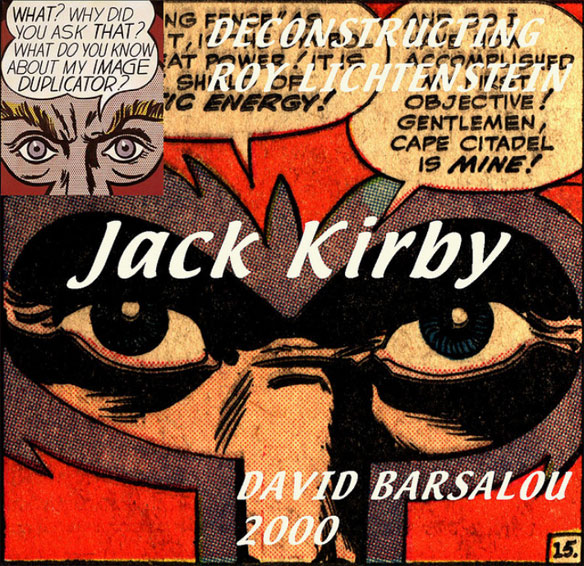
Yes, Lichtenstein even stole from Jack Kirby, the king of comics. No surprise really. Might as well steal from arguably the best, most prolific artists to ever work in comics, right? And hey, if you're going to steal from him, why not bastardize the image as much as possible.
And just in case you can't tell from the extreme close up, the original? That's the X-Men villain, Magneto. And I once again just have to point out how horrible that lettering is. My god. Just take the words out if you can't do it.
 And here's a piece called "Reckon Not, Sir!". If you can't tell, Lichtenstein was a master of titling his work. And if you also can't tell, I'm heavily falling into sarcasm the more I do this. Apologies, but its the only way I can cope with it.
This one here isn't nearly as much a direct copy as others, but it still very clearly is a copy. And, again, a horrible attempt. The cowboy hat put on Lichtenstein's character? There's no way that's actually on his head. Hats don't work like that. That's least two different angles, possibly three. THIS is why I get angry. This kind of thing creates that pervasive talk that comic art is, and always has been, bad. That is CLEARLY not the case.
Joe Kubert, the artist of the original piece from DC Comic's Sgt. Rock, is one of the classic artists that has defined what American comics have looked like. That panel alone is gritty, hard, and filled with intense emotion. It is an amazing piece of art, and guess what? Its tiny. Because its a comic book panel. That takes an intense skill that few have.
And to go a little further, Joe Kubert is no slouch either. The man founded The Kubert School, a technically school entirely focused on teach sequential art and the craft of comics. There is a huge list of alumni from the school that have gone on to work in comics and become famous in their own right, including his two sons, both of whom work in comics today.
 This is the last image I'm going to attack for this post, and there's a specific reason for it. Lichtenstein called this "Seductive Girl", and as you can see from both of his versions, the title is in every way a lie. The life and emotion in this image only came from Mike Sekowsky, as all of that is gone in Lichtenstein's.
And yet, how many that read this know Mike Sekowsky? He worked on so many comics its almost crazy. From superheros like the Justice League of America and Wonder Woman to romance comics, westerns, and war comics. But we see the image there in the bottom right hand corner, those bright, garish colors and the flatness of it all, and we think that's him. We think that because Lichtenstein has helped to paint the image of American comics as low quality art, but the larger image, Sekwosky's actual art, is never seen.
Yes, I'm not the first to rant and rave on this. No, I won't be the last. And I shouldn't be. There is no justification for putting Lichtenstein in a museum when these artist and tons of others have been treated like trash by the art community, first, and then the public at large, second. We give credit to a hack like Lichtenstein and happily claim how good he is compared to those bad old comics, but most people never look at those originals.
Every single art student should. Especially American art students. Why? Its our history. American comics are a truly American style, and there are great, amazing artists that helped to define it and are still changing it today. That's why this blog exists, because I want other artists to know about them. I want teachers to see them and show their students. And I want hacks like Lichtenstein treated like they deserve to be: Liars and thieves.
Next update...I'll go back to talking about artists I love that we should all love. But this needed to get out.
Thursday, June 16, 2011
Gender and Comics
I'm going to divert away from the direct talking about Art in comics to get into something that's been rising it's head more and more over the last few years. When it comes to comics, gender has been an issue for a very long time: Be it in relation to what female characters wear, how they are portrayed, how many exist, how many female creators there are, and the overall makeup of the comic-reading audience.
Part of the reason this has come up on other blogs and on twitter and any other place people discuss comics is due to DC's recently announced relaunch. In September, they are relaunching (nearly) their entire line of comics with new creative teams, altered characters, and somewhat of a clean slate. But as the 52 books being relaunched were announced, a rather glaring thing was noticed: Of the creative teams on all of the books, there is only one woman involved. Gail Simone, one of the best writers in comics, will be co-writing Firestorm and writing Batgirl.
Out of all the other books in the relaunch, the only other women involved are on the editorial and DC staff side. This isn't meant to belittle those people and their jobs, as they are extremely vital, but one woman working on two books out of 52 is a pretty damn small number. And the internet reacted as it does, with some insanity and some good commentary on why this is and why it's bad. So this is my stab at the whole thing.
The first, and arguably most important thing, to get out of the way is very simple: Comics do not appeal to men more than women. As I've stated more than once on this still-small blog, comics are a medium, not a genre. TV does not appeal to men more than women. Books do not. Movies don't. Plays don't. No forms of entertainment do. Mediums are gender neutral. They are simple ways to tell a story and have little to nothing to do with the actual content.
So we break it down further. When many people say women don't like comics, they actually mean women don't like superheroes. In many ways, this is also just as false, but it's possible this is more where the root of the situation is. Superheroes, as a genre, dominate the American comic market to the extent that saying 'comics' to many people just means 'superheroes'. So let's dig into this.
I will make the statement here that I firmly believe: Superhero comics do not inherently appeal to men or women. The current handling of superheroes may appeal more to men, but the idea itself doesn't. The problem, then, is somewhat of a circular situation. Because of the early days of the American comic market, comic books are marketed to the male audience. The comic market is small, so small that the companies cannot afford to risk losing what audience they already have. Sadly, right now, the audience is getting older and the stories are adapting in such a way that even younger audiences, male and female, are being slowly pushed away.
It is a very difficult position. Can these companies afford to take risks on different takes on superhero books? Things that may appeal to younger audiences or to female readers of any age? Every so often, it's attempted. Usually it fails. Sometimes it's never given a chance to get far enough TO fail. The comics business isn't dying, but risks are difficult to take by the larger companies that shape the market, and so we continue to see the same kinds of books over and over.
This is not to say there are not women working in comics. While DC's upcoming relaunch only has one female creator, as noted above, editorial positions are much more largely diverse across the board. In fact, women have held editorial and corporate positions in comics companies for years. And it isn't as if there aren't women that write or draw comics. DC has had more than just one before, as does Marvel. Admittedly, the numbers are always skewed heavily to male creators, but female creators aren't nonexistent.
But not just that, there are even more women in comics when you broaden your scope. The world of manga in Japan is heavily occupied by women, telling all kinds of stories. During the early 2000s, manga was seen as the great way to draw in female readers to comics as a whole, and while it succeeded in part, the fad has since been dying in the states and female readership falling with it. So what does manga have that the mainstream American comics don't, that attracts more women creators and readers?
Simple: Manga is not dominated by a single genre.
And this is where the whole thing gets even trickier. As I've said already, superhero comics are not inherently more for men than for women, yet they are marketed that way and viewed that way by many. But looking at the larger picture, it seems more than superheroes, as a genre, are just as niche a market as Science Fiction, Fantasy, Romance, or what have you. It's not a gender issue, it's a genre issue. Superheroes appeal to some people more than others, and it's generally a smaller group.
The issue of women in comics, both readership and creators, is actually the same piece of a larger problem in comics today. Solving this one thing could, arguably, solve numerous other problems with the market all at once. And in many ways, it is already happening.
The advent and growth of webcomics and the way independent comics are rising today has given a voice to anyone that wants to tell any kind of story with panels and pictures and words. There are humor strips, fantasy epics, scifi space operas, detective stories, noir, romance, war stories, and a thousand other things out there in the world of indie comics. This is where the mantra that comics are for everyone shows through the most. And to bring this back around to the topic at hand, the indie market is flooded with as many women as there are men! They're telling all kinds of stories, just like their male contemporaries.
So here we are at the real point I see at the end of this long debate. Yes, there are problems still with how women are depicted in many comics. Yes, this applies to both what they wear and how they act in many cases. These problems and issues are, however, fading from even the superhero genre as a whole. We no longer live in a time where it's okay to have the Invisible Woman of the Fantastic Four told to get out of the way while the three men of the team take care of the bad guy. Now, she's portrayed as probably the strongest member of the team, and this is just one example. The content problems are changing.
The next step, the step that extends beyond the content and is far more important to the survival of the comic industry as a whole, is to broaden the market as a whole. The means bringing in women, younger readers, and all those other men that still don't read comics because they just don't give a damn about superheroes. And the key to that isn't using a quota system or anything like that, as has been suggested by many who are annoyed by the discussion of women in comics.
Simply, we need a broader selection of genres on the bookshelves that can appeal to any and everyone. Amidst all the doom and gloom that one might hear about the comic market today, I think that this is not only possible, but already happening. And hopefully this will mean more women reading comics, more women making comics, and situations such as the current one at DC becoming a thing of the past.
Part of the reason this has come up on other blogs and on twitter and any other place people discuss comics is due to DC's recently announced relaunch. In September, they are relaunching (nearly) their entire line of comics with new creative teams, altered characters, and somewhat of a clean slate. But as the 52 books being relaunched were announced, a rather glaring thing was noticed: Of the creative teams on all of the books, there is only one woman involved. Gail Simone, one of the best writers in comics, will be co-writing Firestorm and writing Batgirl.
Out of all the other books in the relaunch, the only other women involved are on the editorial and DC staff side. This isn't meant to belittle those people and their jobs, as they are extremely vital, but one woman working on two books out of 52 is a pretty damn small number. And the internet reacted as it does, with some insanity and some good commentary on why this is and why it's bad. So this is my stab at the whole thing.
The first, and arguably most important thing, to get out of the way is very simple: Comics do not appeal to men more than women. As I've stated more than once on this still-small blog, comics are a medium, not a genre. TV does not appeal to men more than women. Books do not. Movies don't. Plays don't. No forms of entertainment do. Mediums are gender neutral. They are simple ways to tell a story and have little to nothing to do with the actual content.
So we break it down further. When many people say women don't like comics, they actually mean women don't like superheroes. In many ways, this is also just as false, but it's possible this is more where the root of the situation is. Superheroes, as a genre, dominate the American comic market to the extent that saying 'comics' to many people just means 'superheroes'. So let's dig into this.
I will make the statement here that I firmly believe: Superhero comics do not inherently appeal to men or women. The current handling of superheroes may appeal more to men, but the idea itself doesn't. The problem, then, is somewhat of a circular situation. Because of the early days of the American comic market, comic books are marketed to the male audience. The comic market is small, so small that the companies cannot afford to risk losing what audience they already have. Sadly, right now, the audience is getting older and the stories are adapting in such a way that even younger audiences, male and female, are being slowly pushed away.
It is a very difficult position. Can these companies afford to take risks on different takes on superhero books? Things that may appeal to younger audiences or to female readers of any age? Every so often, it's attempted. Usually it fails. Sometimes it's never given a chance to get far enough TO fail. The comics business isn't dying, but risks are difficult to take by the larger companies that shape the market, and so we continue to see the same kinds of books over and over.
This is not to say there are not women working in comics. While DC's upcoming relaunch only has one female creator, as noted above, editorial positions are much more largely diverse across the board. In fact, women have held editorial and corporate positions in comics companies for years. And it isn't as if there aren't women that write or draw comics. DC has had more than just one before, as does Marvel. Admittedly, the numbers are always skewed heavily to male creators, but female creators aren't nonexistent.
But not just that, there are even more women in comics when you broaden your scope. The world of manga in Japan is heavily occupied by women, telling all kinds of stories. During the early 2000s, manga was seen as the great way to draw in female readers to comics as a whole, and while it succeeded in part, the fad has since been dying in the states and female readership falling with it. So what does manga have that the mainstream American comics don't, that attracts more women creators and readers?
Simple: Manga is not dominated by a single genre.
And this is where the whole thing gets even trickier. As I've said already, superhero comics are not inherently more for men than for women, yet they are marketed that way and viewed that way by many. But looking at the larger picture, it seems more than superheroes, as a genre, are just as niche a market as Science Fiction, Fantasy, Romance, or what have you. It's not a gender issue, it's a genre issue. Superheroes appeal to some people more than others, and it's generally a smaller group.
The issue of women in comics, both readership and creators, is actually the same piece of a larger problem in comics today. Solving this one thing could, arguably, solve numerous other problems with the market all at once. And in many ways, it is already happening.
The advent and growth of webcomics and the way independent comics are rising today has given a voice to anyone that wants to tell any kind of story with panels and pictures and words. There are humor strips, fantasy epics, scifi space operas, detective stories, noir, romance, war stories, and a thousand other things out there in the world of indie comics. This is where the mantra that comics are for everyone shows through the most. And to bring this back around to the topic at hand, the indie market is flooded with as many women as there are men! They're telling all kinds of stories, just like their male contemporaries.
So here we are at the real point I see at the end of this long debate. Yes, there are problems still with how women are depicted in many comics. Yes, this applies to both what they wear and how they act in many cases. These problems and issues are, however, fading from even the superhero genre as a whole. We no longer live in a time where it's okay to have the Invisible Woman of the Fantastic Four told to get out of the way while the three men of the team take care of the bad guy. Now, she's portrayed as probably the strongest member of the team, and this is just one example. The content problems are changing.
The next step, the step that extends beyond the content and is far more important to the survival of the comic industry as a whole, is to broaden the market as a whole. The means bringing in women, younger readers, and all those other men that still don't read comics because they just don't give a damn about superheroes. And the key to that isn't using a quota system or anything like that, as has been suggested by many who are annoyed by the discussion of women in comics.
Simply, we need a broader selection of genres on the bookshelves that can appeal to any and everyone. Amidst all the doom and gloom that one might hear about the comic market today, I think that this is not only possible, but already happening. And hopefully this will mean more women reading comics, more women making comics, and situations such as the current one at DC becoming a thing of the past.
Subscribe to:
Posts (Atom)