This is going to be a bit of a shorter post than I tend to do, but its a smaller, more concentrated subject that I at least want to hit in some small way. Before I dive into it, though, I feel the need to mention one thing.
I'm thinking the way I'll be doing the more detailed talks on specific artists, such as the Chris Samnee post from a few days ago, is to try and do them once a week. Possibly more in a week, but I don't want to rush them and would prefer to give the artists I talk about a good run through, so once a week seems a safe aim. Admittedly, any schedules I set for this blog are flexible, but hey, worth mentioning.
So with that out of the way, let me get on with this.
I was listening to the wonderful podcast, Word Balloon, hosted by the amazingly entertaining John Suintres, as he did a very long conversation spread over parts with Martin Pasko, a long-time comics creator who has worked since the 70s and also done quite a large amount of television work through the years. The great part about the interviews with Mr. Pasko is his first-hand experience with a great deal of the goings-on at DC through the 70s, which can shine a light on a very interesting period of time for comics, especially for someone my age that wasn't even born yet.
As the discussion rolled around various subjects, it eventually turned to a subject that has struck me far more than I thought it would. The idea of what our heroes should be. Specifically, Mr. Pasko brought this up in regards to the idea that characters like Superman would never have killed back then, whereas today that kind of action is more acceptable.
Now, I was born in the mid-80s, and I've grown up with entertainment in various forms that have created the idea that killing is just normal for many styles of dramatic fiction. This extends from the general faceless deaths from the likes of Stormtroopers in Star Wars to the deaths of major villains to the deaths of heroes themselves. Its just a normal part of storytelling to me, and in fact something I handle without thinking in my own work. People fight, eventually someone dies, the story moves on.
Before I go further, I want to make one point clear. I don't think any of this means that I'm some warped, horrible human being that doesn't see death as a real thing, or any of those other hilariously bad arguments against video game and entertainment violence. I'm speaking strictly in the form of storytelling, and specifically with how it relates to the idea of a hero.
So, now I dive into that. For a very, very long time in comics, death was a very rare, very serious thing. Uncle Ben's death is why Peter Parker is who he is as Spider-Man, and even moreso after the death of Gwen Stacy. The death of Bruce Wayne's parents shapes his need to fight crime so the same thing doesn't happen to others...and probably out of some twisted sense of revenge, depending on your interpretation of how crazy Bruce Wayne might be. But, on the whole, the heroes themselves didn't kill. Punch? Yes. Kick? Yes. But the use of lethal force was mostly restricted to WW2 era comics.
This changed fairly dramatically, as it did in quite a few forms of entertainment, somewhere in the 70s and 80s and grew from there. For comics, the 80s were a definite era of change on the whole. Alan Moore and Dave Gibbons' Watchmen, Frank Miller's Dark Knight Returns, Frank Miller and David Mazzucchelli's Daredevil: Born Again, and X-Men's Dark Phoenix Saga from Chris Claremont, Dave Cockrum, and John Byrne are just a few examples of ways that comics seriously changed in the 80s. The more upbeat comics of the previous few decades began to give way to grittier, angrier, and more cynical stories that tended to have more strongly portrayed violence than before.
Again, this doesn't make them bad. In fact, those stories are all still some of the best comics has to offer, and those are just super hero books, I'm not even getting into indie stuff from the time. But this gave way to the slow move into the stereotype of 90s comics, with giant guns, ultra-violence, and generally an over-the-top atmosphere that I'd be willing to argue is one of the many reasons the entire comic market nearly collapsed.
But comics survived, as they tend to, even if things are smaller now. Still, we now live in an era where the stories in comics are more grounded and real. There's still a certain hardness to many titles, though the overall feel of a heavy darkness and cynical feel is mostly gone. The heroes aren't necessarily as dark as they were, but on the whole, we definitely don't have a return to some of the lighter, older days. In some ways, this is probably for the better, as comics today are full of absolutely amazing stories and artists doing things that wouldn't be possible anytime before.
And this ideal of a hero sits in my mind and I wonder how that has changed. While we still have characters like Superman, Captain America, Spider-Man, and Batman that vow not to kill, it can and does happen. Sometimes for dramatic purposes, sometimes in the more simplistic idea of the last Captain America carrying a gun. There was nothing wrong with it, what with Bucky carrying the mantle and having fought in the war, he'd definitely use a gun and that's fine, but there's no way he didn't kill a few bad guys with it. Otherwise, why use a gun?
The others, too, have all killed in some form through the years. Partly just due to the nature of an ongoing character over decades and decades. New stories are necessary and death and killing are definitely ripe for drama. And I wouldn't say this diminishes the characters in any way either, if anything it could round them out and make them more multi-faceted when handled by a good writer.
But in general, it seems that the idea of the hero that kills is normal today. Think for a moment about a hero of some kind, they don't even have to have superpowers. Is it greater to solve a dangerous situation by finding a peaceful way to save all lives or are some evils just too evil? We seem to definitely be in the age of the latter, and for obvious reasons. But in some ways, it can be hard to look at the opposite, the hero that never takes a life and never lets someone die, as naive and childish.
Is it?
I don't think it is. I think, at the purest form, a hero is better than the rest of us. That's the point. They stand above the masses and do what everyone else can't. They find a way to make the impossible possible. So in this time where it is fairly widely accepted that some people are just too evil to live, isn't a person that can stand above that and say "No, there is another way." and then find that other way, a true hero above us all?
The ability to forgive, unconditionally is somewhere in most of the major religious beliefs of the world, but usually its above the level of the normal man. Isn't that where a hero is? So instead of it being naive, can't this be a great thing?
Clearly, I think there's something to this idea. I do honestly believe that, especially in times like we live in, the heroes that can defy conventional wisdom and save everyone may be what we need in our fiction and entertainment. At the same time, I don't think this should be everything. There's room for everything, but it seems that today, the truly good hero barely exists anymore. I think its time someone found the right way to bring it back, and while I don't claim to know how, with the current crop of writers and creators amongst comics and the entertainment industry as a whole, someone out there is smart enough.

Tuesday, August 16, 2011
Friday, August 12, 2011
Roy Lichtenstein: Plagiarist or Art Thief?
Okay. Before this gets going, two warnings. First: this is likely to be a very long entry. I may even divide it up into two posts. So get comfy. Second: This will, most likely, be my only negative talk about an artist. This is a topic that makes me very angry. In fact, my anger over this topic is part of the reason this blog exists in the first place. There is a distinct possibility I will be much less formal and devolve into angry ranting. I shall do my best to avoid this, but you've been warned. This is something I'm very passionate about.
So. Roy Lichtenstein. His art is loved by artists, teachers, critics, historians, and students alike. Everyone knows "his" work, and those quotes are there for a reason as can likely be inferred from the title of this post alone. Every single art history class mentions him in some form, be it at a high school or college level. He is supposedly a great master of Pop Art, one of the first, even. His taking of comic panels and turning them into larger paintings is still seen as a great use of "low art" and turning it into "high art."
To that, I give you a simple response that can sum up my entire feelings on this without any pretense.
Bull. Shit.
First, it must be made clear that my anger towards Lichtenstein is not because I'm some crazed lover of comics. Clearly, I love comics. Clearly, I believe comics should be treated as art and not some trash to be ignored. And guess what? Lichtenstein is the poster child for the problem. His copies of panels from master comic artists are insipid pieces that only have any life because of the original artists, not his work. Not to mention the fact that nearly all of his copies are inferior to the originals on basic levels, such as line quality, form, etc. And on top of THAT, his lettering is offensively bad all on its own. Oh, and on top of even that, there's the fact that he never credited the original artists, selling his copies for millions while the actual artists saw nothing of it and some spent their lives struggling to make it.
Now before I get into direct comparisons between his "art" and the original works, I want to shoot down the usual counters to these points I'm making. I've already hit on the fact that comics are not "low art" and that the artists behind the originals are worthy of far more praise than they ever have received from the art community, but just keep repeating that because its going in circles in my head.
The other major thing is the idea of Pop Art. One of the other major players in the Pop Art movement was Andy Warhol. Everyone knows his work to some degree. Soup cans, Marilyn Monroe, etc. He stole, too, and while I have a special hatred for some of his work for similar reasons, Lichtenstein was specifically stealing from OTHER artists at the time and essentially taking credit for their work, all the while letting the art world continue to belittle them. But on the idea of Pop Art, the twisting of popular culture into "art" and playing on ideas of mass production and similar themes, Lichtenstein's work STILL doesn't qualify as worthy of praise. Why? Because it is simple plagiarism, at best, and theft, at its worst. Many of the artist he copied were working at the time he was.
This is where the "but all artists steal" comment always comes in. And yes, in many ways, that's true. But that doesn't mean we should condone it, or dismiss the original artists as mere "drawers" as the Lichtenstein Foundation has. But you also have to remember that the only reason Lichtenstein is continued to be seen as such a great artist and thus, can get away with it even after his death, is because he has "historical significance." That's a pathetic way of saying that, yet again, he's better than the original artists despite the fact that doing what he did in any Art School worth its salt would have a student dismissed. You don't get to steal hundreds of pieces of art from other artists and call it your own, especially if you refuse to admit they existed or did anything of significance before you came along and did your thing. That's just called being an asshole.
So suck it up and accept the truth. Lichtenstein was a hack that couldn't paint well even when he copied, and now's the part where I start posting images to show that.
But yet again, one more thing crops up that I must mention. The images I'll be using are from an man named David Barsalou, who's been working for over three decades to find the original sources of many of Lichtenstein's paintings. He has an amazing Flickr page with tons and tons of these, with bits and pieces of info attached to the images and well worth looking through. I'm only going to highlight a few.

So right there is one of Lichtenstein's most famous pieces. He called it "WHAAM!" because of...well, obviously, the sound effect. The original is the top piece, and its from All-American Men at War #89, drawn by a man named Russ Heath. Looking at both side by side, sort of, it should be strikingly obvious which one is a copy and which one is an actual piece of art. Lichtenstein's copy of it is stunted, and badly rendered, despite the fact that he projected the images larger and TRACED them. There is no life to his copy, where as Heath's screams movement and force, emphasized as much be the missile as by a more strongly created and placed sound effect.
And make sure to look at Lichtenstein's attempt at lettering. Not only does he place the caption box in such a way that it looks like a damned flag on the tail of the plane, but his construction of the letters alone is simple sloppy and bad.

Here's another of Lichtenstein's famous pieces, he called it "Drowning Girl." This is, in fact, and obvious if you can read basic English on that image above, actually by an artist named Tony Abruzzo. It is likely from DC's first romance book that started in 1949, called Girls' Love Stories, a title that featured art by many of the great names in comic art.
So what makes Lichtenstien's version of it, the smaller one, art? Nothing. Nothing that wouldn't invalidate them both. All that he did to change it was his usual bad lettering, removing a line of the dialogue, and cropping it just a bit more. So why does Lichtenstein get credit for this and not Abruzzo? Hell, I'll admit, I didn't even know Abruzzo until I hunted information on him, and that is a DAMN shame.

Yes, Lichtenstein even stole from Jack Kirby, the king of comics. No surprise really. Might as well steal from arguably the best, most prolific artists to ever work in comics, right? And hey, if you're going to steal from him, why not bastardize the image as much as possible.
And just in case you can't tell from the extreme close up, the original? That's the X-Men villain, Magneto. And I once again just have to point out how horrible that lettering is. My god. Just take the words out if you can't do it.
 And here's a piece called "Reckon Not, Sir!". If you can't tell, Lichtenstein was a master of titling his work. And if you also can't tell, I'm heavily falling into sarcasm the more I do this. Apologies, but its the only way I can cope with it.
This one here isn't nearly as much a direct copy as others, but it still very clearly is a copy. And, again, a horrible attempt. The cowboy hat put on Lichtenstein's character? There's no way that's actually on his head. Hats don't work like that. That's least two different angles, possibly three. THIS is why I get angry. This kind of thing creates that pervasive talk that comic art is, and always has been, bad. That is CLEARLY not the case.
Joe Kubert, the artist of the original piece from DC Comic's Sgt. Rock, is one of the classic artists that has defined what American comics have looked like. That panel alone is gritty, hard, and filled with intense emotion. It is an amazing piece of art, and guess what? Its tiny. Because its a comic book panel. That takes an intense skill that few have.
And to go a little further, Joe Kubert is no slouch either. The man founded The Kubert School, a technically school entirely focused on teach sequential art and the craft of comics. There is a huge list of alumni from the school that have gone on to work in comics and become famous in their own right, including his two sons, both of whom work in comics today.
 This is the last image I'm going to attack for this post, and there's a specific reason for it. Lichtenstein called this "Seductive Girl", and as you can see from both of his versions, the title is in every way a lie. The life and emotion in this image only came from Mike Sekowsky, as all of that is gone in Lichtenstein's.
And yet, how many that read this know Mike Sekowsky? He worked on so many comics its almost crazy. From superheros like the Justice League of America and Wonder Woman to romance comics, westerns, and war comics. But we see the image there in the bottom right hand corner, those bright, garish colors and the flatness of it all, and we think that's him. We think that because Lichtenstein has helped to paint the image of American comics as low quality art, but the larger image, Sekwosky's actual art, is never seen.
Yes, I'm not the first to rant and rave on this. No, I won't be the last. And I shouldn't be. There is no justification for putting Lichtenstein in a museum when these artist and tons of others have been treated like trash by the art community, first, and then the public at large, second. We give credit to a hack like Lichtenstein and happily claim how good he is compared to those bad old comics, but most people never look at those originals.
Every single art student should. Especially American art students. Why? Its our history. American comics are a truly American style, and there are great, amazing artists that helped to define it and are still changing it today. That's why this blog exists, because I want other artists to know about them. I want teachers to see them and show their students. And I want hacks like Lichtenstein treated like they deserve to be: Liars and thieves.
Next update...I'll go back to talking about artists I love that we should all love. But this needed to get out.
So. Roy Lichtenstein. His art is loved by artists, teachers, critics, historians, and students alike. Everyone knows "his" work, and those quotes are there for a reason as can likely be inferred from the title of this post alone. Every single art history class mentions him in some form, be it at a high school or college level. He is supposedly a great master of Pop Art, one of the first, even. His taking of comic panels and turning them into larger paintings is still seen as a great use of "low art" and turning it into "high art."
To that, I give you a simple response that can sum up my entire feelings on this without any pretense.
Bull. Shit.
First, it must be made clear that my anger towards Lichtenstein is not because I'm some crazed lover of comics. Clearly, I love comics. Clearly, I believe comics should be treated as art and not some trash to be ignored. And guess what? Lichtenstein is the poster child for the problem. His copies of panels from master comic artists are insipid pieces that only have any life because of the original artists, not his work. Not to mention the fact that nearly all of his copies are inferior to the originals on basic levels, such as line quality, form, etc. And on top of THAT, his lettering is offensively bad all on its own. Oh, and on top of even that, there's the fact that he never credited the original artists, selling his copies for millions while the actual artists saw nothing of it and some spent their lives struggling to make it.
Now before I get into direct comparisons between his "art" and the original works, I want to shoot down the usual counters to these points I'm making. I've already hit on the fact that comics are not "low art" and that the artists behind the originals are worthy of far more praise than they ever have received from the art community, but just keep repeating that because its going in circles in my head.
The other major thing is the idea of Pop Art. One of the other major players in the Pop Art movement was Andy Warhol. Everyone knows his work to some degree. Soup cans, Marilyn Monroe, etc. He stole, too, and while I have a special hatred for some of his work for similar reasons, Lichtenstein was specifically stealing from OTHER artists at the time and essentially taking credit for their work, all the while letting the art world continue to belittle them. But on the idea of Pop Art, the twisting of popular culture into "art" and playing on ideas of mass production and similar themes, Lichtenstein's work STILL doesn't qualify as worthy of praise. Why? Because it is simple plagiarism, at best, and theft, at its worst. Many of the artist he copied were working at the time he was.
This is where the "but all artists steal" comment always comes in. And yes, in many ways, that's true. But that doesn't mean we should condone it, or dismiss the original artists as mere "drawers" as the Lichtenstein Foundation has. But you also have to remember that the only reason Lichtenstein is continued to be seen as such a great artist and thus, can get away with it even after his death, is because he has "historical significance." That's a pathetic way of saying that, yet again, he's better than the original artists despite the fact that doing what he did in any Art School worth its salt would have a student dismissed. You don't get to steal hundreds of pieces of art from other artists and call it your own, especially if you refuse to admit they existed or did anything of significance before you came along and did your thing. That's just called being an asshole.
So suck it up and accept the truth. Lichtenstein was a hack that couldn't paint well even when he copied, and now's the part where I start posting images to show that.
But yet again, one more thing crops up that I must mention. The images I'll be using are from an man named David Barsalou, who's been working for over three decades to find the original sources of many of Lichtenstein's paintings. He has an amazing Flickr page with tons and tons of these, with bits and pieces of info attached to the images and well worth looking through. I'm only going to highlight a few.

So right there is one of Lichtenstein's most famous pieces. He called it "WHAAM!" because of...well, obviously, the sound effect. The original is the top piece, and its from All-American Men at War #89, drawn by a man named Russ Heath. Looking at both side by side, sort of, it should be strikingly obvious which one is a copy and which one is an actual piece of art. Lichtenstein's copy of it is stunted, and badly rendered, despite the fact that he projected the images larger and TRACED them. There is no life to his copy, where as Heath's screams movement and force, emphasized as much be the missile as by a more strongly created and placed sound effect.
And make sure to look at Lichtenstein's attempt at lettering. Not only does he place the caption box in such a way that it looks like a damned flag on the tail of the plane, but his construction of the letters alone is simple sloppy and bad.

Here's another of Lichtenstein's famous pieces, he called it "Drowning Girl." This is, in fact, and obvious if you can read basic English on that image above, actually by an artist named Tony Abruzzo. It is likely from DC's first romance book that started in 1949, called Girls' Love Stories, a title that featured art by many of the great names in comic art.
So what makes Lichtenstien's version of it, the smaller one, art? Nothing. Nothing that wouldn't invalidate them both. All that he did to change it was his usual bad lettering, removing a line of the dialogue, and cropping it just a bit more. So why does Lichtenstein get credit for this and not Abruzzo? Hell, I'll admit, I didn't even know Abruzzo until I hunted information on him, and that is a DAMN shame.
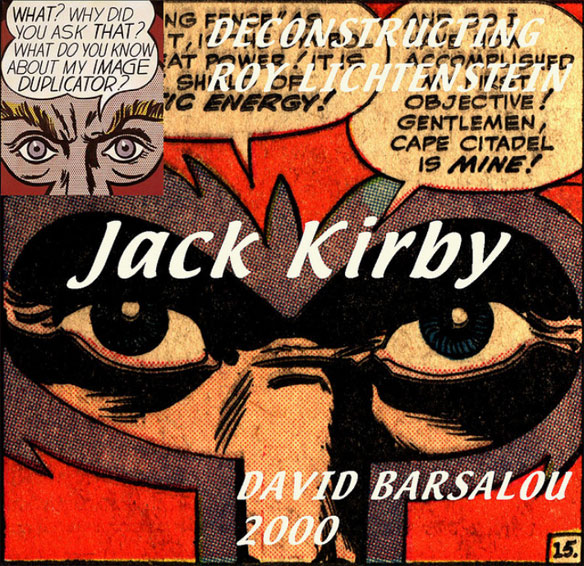
Yes, Lichtenstein even stole from Jack Kirby, the king of comics. No surprise really. Might as well steal from arguably the best, most prolific artists to ever work in comics, right? And hey, if you're going to steal from him, why not bastardize the image as much as possible.
And just in case you can't tell from the extreme close up, the original? That's the X-Men villain, Magneto. And I once again just have to point out how horrible that lettering is. My god. Just take the words out if you can't do it.
 And here's a piece called "Reckon Not, Sir!". If you can't tell, Lichtenstein was a master of titling his work. And if you also can't tell, I'm heavily falling into sarcasm the more I do this. Apologies, but its the only way I can cope with it.
This one here isn't nearly as much a direct copy as others, but it still very clearly is a copy. And, again, a horrible attempt. The cowboy hat put on Lichtenstein's character? There's no way that's actually on his head. Hats don't work like that. That's least two different angles, possibly three. THIS is why I get angry. This kind of thing creates that pervasive talk that comic art is, and always has been, bad. That is CLEARLY not the case.
Joe Kubert, the artist of the original piece from DC Comic's Sgt. Rock, is one of the classic artists that has defined what American comics have looked like. That panel alone is gritty, hard, and filled with intense emotion. It is an amazing piece of art, and guess what? Its tiny. Because its a comic book panel. That takes an intense skill that few have.
And to go a little further, Joe Kubert is no slouch either. The man founded The Kubert School, a technically school entirely focused on teach sequential art and the craft of comics. There is a huge list of alumni from the school that have gone on to work in comics and become famous in their own right, including his two sons, both of whom work in comics today.
 This is the last image I'm going to attack for this post, and there's a specific reason for it. Lichtenstein called this "Seductive Girl", and as you can see from both of his versions, the title is in every way a lie. The life and emotion in this image only came from Mike Sekowsky, as all of that is gone in Lichtenstein's.
And yet, how many that read this know Mike Sekowsky? He worked on so many comics its almost crazy. From superheros like the Justice League of America and Wonder Woman to romance comics, westerns, and war comics. But we see the image there in the bottom right hand corner, those bright, garish colors and the flatness of it all, and we think that's him. We think that because Lichtenstein has helped to paint the image of American comics as low quality art, but the larger image, Sekwosky's actual art, is never seen.
Yes, I'm not the first to rant and rave on this. No, I won't be the last. And I shouldn't be. There is no justification for putting Lichtenstein in a museum when these artist and tons of others have been treated like trash by the art community, first, and then the public at large, second. We give credit to a hack like Lichtenstein and happily claim how good he is compared to those bad old comics, but most people never look at those originals.
Every single art student should. Especially American art students. Why? Its our history. American comics are a truly American style, and there are great, amazing artists that helped to define it and are still changing it today. That's why this blog exists, because I want other artists to know about them. I want teachers to see them and show their students. And I want hacks like Lichtenstein treated like they deserve to be: Liars and thieves.
Next update...I'll go back to talking about artists I love that we should all love. But this needed to get out.

Wednesday, August 10, 2011
Comic Artists You Should Know: Chris Samnee
Okay, here we go. Back from a little time away from this blog and through most of those early posts that I felt were necessary before really diving into the meat of what I want to do here. Its time to talk about a specific artist in the comic world. As with most things I tend to hit on, the goal is to show that comics are more than many people seem to think and that they deserve a great deal more attention in all aspects, but especially in the art world.
Normally, this is the point where you go straight to the king of comics, Jack Kirby. He's the man to really influence everything that's come since in a way that no one else has. There's a long list of other huge names in the comic world when it comes to art (Steranko, Ditko, Romita, Moebius, Perez, just to name a few), but I want to hit on someone newer to start this off. Those guys have been covered in a ton of places by smarter people than I, and while I'll likely get to them at some point, I'd like to try some names that are even less likely to be known to people that care about art.
So we begin with Chris Samnee, a relatively new talent in the industry. Very relatively, as he's been working for quite a few years now, but the comic world is full of "Hot New Artist!"s that have been working for years and years and only suddenly received the attention they deserve. He's done work for most of the major companies, Marvel, DC, Dark Horse, Vertigo, and Oni Press, just to name a few. But he really caught the attention of readers with 2010's Thor: The Mighty Avenger, written by Roger Langridge.
 Above is one of Samnee's covers for Thor: The Mighty Avenger (and as usual, make sure to click on the image to see it larger), and it is pretty much a perfect example of his work. He pencils and inks himself, and the truly noticeable part of that is Samnee's masterful use of blacks and negative space. He is one of the few artists currently working in comics to so strongly use blacks in an effective way, and is able to use it to imply linework that isn't even there. While, of course, implied line is one of those basics of art that is taught in pretty much any Drawing I class worth its salt, the use of it is rarely as effective in actual practice in modern comics anywhere but with Samnee's work.
And then there are the more obvious qualities to his art: Strong motion and pitch-perfect emotions. No one ever stands around looking boring in a Samnee-drawn comic, and he has a way of drawing a 'talking heads' scene that can be as exciting as a fight. Emotion is captured and exaggerated in just the right ways to say everything that is needed.

On top of all of this is Samnee's style. Many would call it "cartoony", which does the work a great disservice. His art harkens back to Silver Age comics, a style that many that don't read comics (and many that do, admittedly), see as childish, weak, and simple. This is, of course, not the case at all. The admittedly more simple styles of early comic books and comic strips should never be so quickly dismissed, as Samnee's modern take on the same clean, simple style easily shows.
 Above is a piece that Samnee did for Comic Twart, Superman: The Movie in six panels. Its simple, and nails the entirety of the film in such a short space. While not the best example of showing how he can lay out a single page to tell a story, as this jumps large amounts of time, I think it DOES show a strength in storytelling nonetheless. There is much to be said about capturing a full length movie in six simple panels, and Samnee nails them in more ways than just reproducing what is seen in the film. Angle, expressions, use of black, and the choice of key moments is what pulls it together and really shows a grasp of storytelling that most of us can only hope for. Not to mention that he made sure to keep "Otisburg" on Luthor's map, which is just wonderful and fun if you know the movie.
 Its hard for me to say much more about his work without devolving into repeating myself. I could go on and on in circles about the use of blacks and negative space and just how well Samnee can tell a story or draw a simple pin up that can put a smile on anyone's face. So its likely best I wrap this post up, but I have a couple more things to mention before I finally hit the 'publish post' button staring at me right now.
First, is a bit more expanding on just WHY I picked Chris Samnee as the first artist to talk about. There's more to it than just not wanting to pick the traditional guys to talk about when trying to explain to other artists (or anyone, for that matter) just why comic art matters and is more than second-rate crap as many in the world (art world and just the world) tend to see it. A larger reason is that I look at Samnee's art and I'm blown away. I look at what he does and how well he does it, and I want to be able to do that. His art inspires me in a way that few others ever have. I'd like to think that one day, after my wife and I have both spent years fighting together to make comics of our own, that I can be half as good as Samnee. I'd like to think that if his art can have such a strong affect on me, maybe one of the few people that read this can have a similar experience. Because, as I've said in every single post and will likely keep saying until I'm physically restrained from doing so, comics matter and they are legitimate art. And Chris Samnee is a prime example of why, and he's working right now.
So with that in mind, here's a tiny sampling of where to find his work and just what's out there that Chris Samnee has worked on. I highly suggest checking out his website, www.chrissamnee.com, where he constantly posts amazing pin ups such as the Cyclops and Daredevil shown above. Of course, the best way to get more of his work is in the comics, and the full run of Thor: The Mighty Avenger is out right now in two digest-sized trades, along with Serenity: A Shepherd's Tale with Joss and Zack Whedon. Currently drawing the monthly title for Marvel, Captain America and Bucky, written by Ed Brubaker.
Normally, this is the point where you go straight to the king of comics, Jack Kirby. He's the man to really influence everything that's come since in a way that no one else has. There's a long list of other huge names in the comic world when it comes to art (Steranko, Ditko, Romita, Moebius, Perez, just to name a few), but I want to hit on someone newer to start this off. Those guys have been covered in a ton of places by smarter people than I, and while I'll likely get to them at some point, I'd like to try some names that are even less likely to be known to people that care about art.
So we begin with Chris Samnee, a relatively new talent in the industry. Very relatively, as he's been working for quite a few years now, but the comic world is full of "Hot New Artist!"s that have been working for years and years and only suddenly received the attention they deserve. He's done work for most of the major companies, Marvel, DC, Dark Horse, Vertigo, and Oni Press, just to name a few. But he really caught the attention of readers with 2010's Thor: The Mighty Avenger, written by Roger Langridge.
 Above is one of Samnee's covers for Thor: The Mighty Avenger (and as usual, make sure to click on the image to see it larger), and it is pretty much a perfect example of his work. He pencils and inks himself, and the truly noticeable part of that is Samnee's masterful use of blacks and negative space. He is one of the few artists currently working in comics to so strongly use blacks in an effective way, and is able to use it to imply linework that isn't even there. While, of course, implied line is one of those basics of art that is taught in pretty much any Drawing I class worth its salt, the use of it is rarely as effective in actual practice in modern comics anywhere but with Samnee's work.
And then there are the more obvious qualities to his art: Strong motion and pitch-perfect emotions. No one ever stands around looking boring in a Samnee-drawn comic, and he has a way of drawing a 'talking heads' scene that can be as exciting as a fight. Emotion is captured and exaggerated in just the right ways to say everything that is needed.

On top of all of this is Samnee's style. Many would call it "cartoony", which does the work a great disservice. His art harkens back to Silver Age comics, a style that many that don't read comics (and many that do, admittedly), see as childish, weak, and simple. This is, of course, not the case at all. The admittedly more simple styles of early comic books and comic strips should never be so quickly dismissed, as Samnee's modern take on the same clean, simple style easily shows.
 Above is a piece that Samnee did for Comic Twart, Superman: The Movie in six panels. Its simple, and nails the entirety of the film in such a short space. While not the best example of showing how he can lay out a single page to tell a story, as this jumps large amounts of time, I think it DOES show a strength in storytelling nonetheless. There is much to be said about capturing a full length movie in six simple panels, and Samnee nails them in more ways than just reproducing what is seen in the film. Angle, expressions, use of black, and the choice of key moments is what pulls it together and really shows a grasp of storytelling that most of us can only hope for. Not to mention that he made sure to keep "Otisburg" on Luthor's map, which is just wonderful and fun if you know the movie.
 Its hard for me to say much more about his work without devolving into repeating myself. I could go on and on in circles about the use of blacks and negative space and just how well Samnee can tell a story or draw a simple pin up that can put a smile on anyone's face. So its likely best I wrap this post up, but I have a couple more things to mention before I finally hit the 'publish post' button staring at me right now.
First, is a bit more expanding on just WHY I picked Chris Samnee as the first artist to talk about. There's more to it than just not wanting to pick the traditional guys to talk about when trying to explain to other artists (or anyone, for that matter) just why comic art matters and is more than second-rate crap as many in the world (art world and just the world) tend to see it. A larger reason is that I look at Samnee's art and I'm blown away. I look at what he does and how well he does it, and I want to be able to do that. His art inspires me in a way that few others ever have. I'd like to think that one day, after my wife and I have both spent years fighting together to make comics of our own, that I can be half as good as Samnee. I'd like to think that if his art can have such a strong affect on me, maybe one of the few people that read this can have a similar experience. Because, as I've said in every single post and will likely keep saying until I'm physically restrained from doing so, comics matter and they are legitimate art. And Chris Samnee is a prime example of why, and he's working right now.
So with that in mind, here's a tiny sampling of where to find his work and just what's out there that Chris Samnee has worked on. I highly suggest checking out his website, www.chrissamnee.com, where he constantly posts amazing pin ups such as the Cyclops and Daredevil shown above. Of course, the best way to get more of his work is in the comics, and the full run of Thor: The Mighty Avenger is out right now in two digest-sized trades, along with Serenity: A Shepherd's Tale with Joss and Zack Whedon. Currently drawing the monthly title for Marvel, Captain America and Bucky, written by Ed Brubaker.
Friday, June 24, 2011
On Captain America
With the live action movie starring Chris Evans coming this Friday, I feel like now is about the best time to put down some thoughts in regards to Captain America. The prompting of this is fairly simple. I feel like many people see the costume and hear the name and judge the character without any other thoughts. This is, of course, unfair to any character of any medium, but as I was once guilty of this with Cap, specifically, I wanted to put down why this has changed for me and why I think it should for others.
So basically, the reasoning is very similar to my general talks on comic art and the medium: Why does it mean and why does it matter?
 The best place to start is, of course, at the beginning. Captain America was created by Joe Simon and Jack Kirby in 1941, part of Timely Comics, the company that would eventually become Marvel Comics. The basics of the character are pretty simple. A young, weak, skinny kid named Steve Rogers wants to fight in WWII like everyone else his age, but isn't allowed to sign up due to being so weak and small. Instead, he is given the chance to take part in a top secret project, Operation: Rebirth, with the goal of creating the perfect soldier. Rogers is selected as the first test subject, and it succeeds, transforming him into the a strong, perfect human specimen, but the project is sabotaged leaving him the only Super Soldier created by the project.
From there, Cap goes to fight in WWII. He servers as a symbol to the troops and fights Nazi super soldiers and mad scientists during the war, until being presumably killed in action attempting to stop an experimental plane late in the war. In fact, Cap is not killed, but falls into the ocean and is frozen in the ice until being found in the 1960s, then joining the newly-formed Avengers with Iron Man, The Hulk, Wasp, Giant Man, and Thor, and that's when the more typical super hero things begin.
Since then, the usual insanity of a 50 years of publishing serialized stories has occurred, with Cap having done everything from fighting aliens in space, giving up the mantle of Captain America, and even the requisite super hero death and return.
There have even been others to take up the Captain America name, most recently his former sidekick Bucky, but the fact remains that Steve Rogers will always be the Captain America we think of the most. Any detours from this path tend to be temporary and mainly to explore other aspects of the character.
And that, right there, is what I want to get into. The character of Steve Rogers.
It is extremely easy to dismiss Captain America as a jingoistic, overly-patriotic anachronism. Hell, his costume is pretty much the American flag. But that is very much judging a book by its cover. While draped in those colors, the real focus is not on patriotism or some nationalistic push, but instead what it is to be good. Steve Rogers, at his core, is a good man. He does what is right because it is right, not for some political ideal. Cap is, or at least should be, above politics and nationalism.
He is the American ideal, yes, but he's also more than that. He is a human ideal, and not just physically. In many ways, he is comparable to Superman. They are the pinnacles of good in their respective universes, the role models that everyone looks up to, and the ones that never flinch in the face of evil. They are, put simply, true heroes. But while there are countless similarities, a key difference that truly defines Captain America remains.
Superman is an alien. He is from another planet, has powers we can only dream of, and is simply not human despite how close he may seem. Captain America is human. He has all of our faults, yet through it all is able to remain good. His powers are super human, yes, but to a degree that one could argue is attainable more than things like flight or heat vision or anything like that. Captain America is us. He is an ideal that is within reach for the common man in some way.
That is because the essence of what makes Captain America what he is does not come from the super strength or the costume or the title. The essence of it all is Steve Rogers. The kid from Brooklyn that always had the strong convictions and good heart that made him the hero he became. He may have been a scrawny kid, but his true strength comes from his desire to do good. And even with all the powers, that is who Steve Rogers has remained. That is why no one can really replace him as Captain America.
And that is why Captain America matters.
He may fight Nazis, aliens, super soldiers, mad scientists, and a few random criminals, but he is what we should all attempt to be in the end: A good man.
So basically, the reasoning is very similar to my general talks on comic art and the medium: Why does it mean and why does it matter?
 The best place to start is, of course, at the beginning. Captain America was created by Joe Simon and Jack Kirby in 1941, part of Timely Comics, the company that would eventually become Marvel Comics. The basics of the character are pretty simple. A young, weak, skinny kid named Steve Rogers wants to fight in WWII like everyone else his age, but isn't allowed to sign up due to being so weak and small. Instead, he is given the chance to take part in a top secret project, Operation: Rebirth, with the goal of creating the perfect soldier. Rogers is selected as the first test subject, and it succeeds, transforming him into the a strong, perfect human specimen, but the project is sabotaged leaving him the only Super Soldier created by the project.
From there, Cap goes to fight in WWII. He servers as a symbol to the troops and fights Nazi super soldiers and mad scientists during the war, until being presumably killed in action attempting to stop an experimental plane late in the war. In fact, Cap is not killed, but falls into the ocean and is frozen in the ice until being found in the 1960s, then joining the newly-formed Avengers with Iron Man, The Hulk, Wasp, Giant Man, and Thor, and that's when the more typical super hero things begin.
Since then, the usual insanity of a 50 years of publishing serialized stories has occurred, with Cap having done everything from fighting aliens in space, giving up the mantle of Captain America, and even the requisite super hero death and return.
There have even been others to take up the Captain America name, most recently his former sidekick Bucky, but the fact remains that Steve Rogers will always be the Captain America we think of the most. Any detours from this path tend to be temporary and mainly to explore other aspects of the character.
And that, right there, is what I want to get into. The character of Steve Rogers.
It is extremely easy to dismiss Captain America as a jingoistic, overly-patriotic anachronism. Hell, his costume is pretty much the American flag. But that is very much judging a book by its cover. While draped in those colors, the real focus is not on patriotism or some nationalistic push, but instead what it is to be good. Steve Rogers, at his core, is a good man. He does what is right because it is right, not for some political ideal. Cap is, or at least should be, above politics and nationalism.
He is the American ideal, yes, but he's also more than that. He is a human ideal, and not just physically. In many ways, he is comparable to Superman. They are the pinnacles of good in their respective universes, the role models that everyone looks up to, and the ones that never flinch in the face of evil. They are, put simply, true heroes. But while there are countless similarities, a key difference that truly defines Captain America remains.
Superman is an alien. He is from another planet, has powers we can only dream of, and is simply not human despite how close he may seem. Captain America is human. He has all of our faults, yet through it all is able to remain good. His powers are super human, yes, but to a degree that one could argue is attainable more than things like flight or heat vision or anything like that. Captain America is us. He is an ideal that is within reach for the common man in some way.
That is because the essence of what makes Captain America what he is does not come from the super strength or the costume or the title. The essence of it all is Steve Rogers. The kid from Brooklyn that always had the strong convictions and good heart that made him the hero he became. He may have been a scrawny kid, but his true strength comes from his desire to do good. And even with all the powers, that is who Steve Rogers has remained. That is why no one can really replace him as Captain America.
And that is why Captain America matters.
He may fight Nazis, aliens, super soldiers, mad scientists, and a few random criminals, but he is what we should all attempt to be in the end: A good man.
Friday, June 17, 2011
How Comics Are Made
I'm to the point of wanting to start diving into specific artists, but before doing that, realized it would be best to nail down the process behind things first. Talking in detail about how great an inker is doesn't do much good if the reader doesn't have a knowledge of inker that extends beyond 'tracer'.
That means this post is dedicated to breaking down the different types of things that go into making comics. Now, the focus here is on American comics, as the techniques and some roles don't exist in other types of comics around the world. And even then, this is generalized. Not all comics use all of these roles. Some are painted, some aren't inked, some are silent and lettering isn't necessary, etc. You get the point.
Attached we have examples of various stages (script, inks, and colors) to help show how things change and look at various stages. These are from a book from Marvel a few years back: Immortal Iron Fist #1. It was written by both Ed Brubaker and Matt Fraction, and the pencils and inks were handled by David Aja, with Matt Hollingsworth on the colors. I apologize for not having the pencils to compare but Aja handled both the pencils and inks, and my best efforts to find the pencils have failed. Still, this should give a good visual idea of how things work, especially from the script to art stage. And I highly, HIGHLY recommend clicking the thumbnails to get a better look at the images. The thumbnails really don't do Aja's art any justice.
So I'll start at the 'usual' beginning.

Writer: A writer does about what you'd expect in comics. They write. Shocking, I know. What's worth mentioning here is the how, as it can vary from writer to writer. There is no standard form of a comic script. These days, it isn't uncommon for a writer to use a screenplay style very similar to movies and television scripts, but it is in no way universal. Many writers break things down as simply as a basic panel description of what they want the artist to draw, and a few lines of dialogue, with little else. Some, like Alan Moore, can writer pages on how the mood and feel of a single panel on a page should be.
It really comes down to how the writer and artist work together. Some artists love a stricter breakdown, while some love the freedom of just being told "They fight, have fun" in a script. This is taken to the extreme in what is called "Marvel Style", called as such because of how common it was during some of the earlier days of Marvel thanks to Stan Lee. With this style, the writer just gives the artist a basic plot outline for the entire issue, with no real breakdowns, and then the artist sends back pages and pages. With that, the writer THEN puts in the dialogue. With Marvel Style stories, the artist is much more intimately involved in the writer process, and it's something that some people swear by.
Layout Artist: This is one of those roles that is many times wrapped under the label of penciler. But there are some artists that simply take the script and do breakdowns, or layouts. Sometimes it's to save time for the penciler, sometimes not. Some pencil artists like to have another hand to help them break down panel shapes and the overall way a page flows.
Pencil Artist: Here's the artist that usually gets the most attention. This is the person putting down the final, well worked pencils that determine pretty much everything. All the art on the page is based off of what happens here. If there is no layout artist, this is the artist who truly sets the flow for the page. A good pencil artist is essential to a readable book.
Where the writer sets down the words and the idea, it's the pencil artist that sets it all into motion. In some terms, they could be seen as the director of the movie, putting their vision onto the page from the framework of the script. But there is more to it: The penciler is also all the actors, the set designer, and everything else. This is a stage that can truly make or break a book in how you relate to the characters, or simply if you can read the panels in the correct order.
Storytelling ability is king here even more than rendering the art perfectly.

Inker: This is not the 'tracer' as some would say. In every single way, that is a failing to understand what an inker actually brings to a comic. Years ago, inkers were credited as an Embellisher, and that's still a very good way to look at this step. An inker takes the pencils and renders them in solid blacks and whites, sometimes with tones of grey depending on the medium they've chosen to use.
The importance of the inker is in bringing to life and shaping the forms the pencil artist has already put down. Solid, strong blacks are a staple of American comics, and balancing those on a page is a subtle and essential art. In many ways, this can be seen as a type of extremely nuanced and very important shading on every aspect of the art.

Colorist: Here is another more self-explanatory person in the making of a comic. The colorist, obviously, colors. But this goes further than simply keeping in the lines and making things pretty. All the fundamentals of color theory apply here and are vital to making or breaking the overall work.
The inker has already given a strong pass of blacks and whites, which can help to determine where the shadows are, but a good colorist can make them even better. Color pallets make or break a story, just like they do for any other work of art. Sometimes a flat coloring style is used that resembles the older, four-color process that we're used to seeing in the comics from the 60s and 70s, but other times the art is fully painted: be that digitally or traditionally.
Letterer: And now, with all the art down and, hopefully, finished, another important person in the process comes in. The letterer adds nearly all the text. Word balloons, captions, title pages, etc. All of that is for the letterer to do, as are many sound effects that aren't necessary integrated into the art by the pencil artist.
While all of this is, obviously, important, the letterer does something else that is more subtle but is arguably one of the most important parts of a comic book. In placing word balloons and captions, the letterer will show the reader how to read the book. A good letterer will bring your eyes along the image that the pencil artist has already set up, from one piece of text to the image to another. This can go in traditional, left to right manner, or, if done with skill, back and forth in nearly random patterns that follow the art.
Everyone Else: And that is in NO WAY the entirety of people needed to make a comic, but those are who we're focusing on. Beyond them? You've got editors holding the communication lines between them all and making sure the book actually comes together, assistant editors trying to keep whatever they're assigned to straight, cover artist (usually a different artist than those working on the interiors of a book), graphic designers to help with everything from logos to organizing cover designs, to the interns helping wherever they're ordered to and hoping to one day turn the internship into a job. And even THAT isn't everyone, but you get the picture.
Comics come about due to the effort of a great many people. Sometimes. Other times? One person does it all. Sometimes there are only two. But one way or another, most of these things tend to be necessary for a comic to happen. Sometimes the same person does multiple parts of the process, as we see here with David Aja penciling and inking the work. Okay, we don't see the pencils, but you get the idea.
I hope.
Once I get to talking about specific artists, we shall see if this very brief overview has done any good.
That means this post is dedicated to breaking down the different types of things that go into making comics. Now, the focus here is on American comics, as the techniques and some roles don't exist in other types of comics around the world. And even then, this is generalized. Not all comics use all of these roles. Some are painted, some aren't inked, some are silent and lettering isn't necessary, etc. You get the point.
Attached we have examples of various stages (script, inks, and colors) to help show how things change and look at various stages. These are from a book from Marvel a few years back: Immortal Iron Fist #1. It was written by both Ed Brubaker and Matt Fraction, and the pencils and inks were handled by David Aja, with Matt Hollingsworth on the colors. I apologize for not having the pencils to compare but Aja handled both the pencils and inks, and my best efforts to find the pencils have failed. Still, this should give a good visual idea of how things work, especially from the script to art stage. And I highly, HIGHLY recommend clicking the thumbnails to get a better look at the images. The thumbnails really don't do Aja's art any justice.
So I'll start at the 'usual' beginning.

Writer: A writer does about what you'd expect in comics. They write. Shocking, I know. What's worth mentioning here is the how, as it can vary from writer to writer. There is no standard form of a comic script. These days, it isn't uncommon for a writer to use a screenplay style very similar to movies and television scripts, but it is in no way universal. Many writers break things down as simply as a basic panel description of what they want the artist to draw, and a few lines of dialogue, with little else. Some, like Alan Moore, can writer pages on how the mood and feel of a single panel on a page should be.
It really comes down to how the writer and artist work together. Some artists love a stricter breakdown, while some love the freedom of just being told "They fight, have fun" in a script. This is taken to the extreme in what is called "Marvel Style", called as such because of how common it was during some of the earlier days of Marvel thanks to Stan Lee. With this style, the writer just gives the artist a basic plot outline for the entire issue, with no real breakdowns, and then the artist sends back pages and pages. With that, the writer THEN puts in the dialogue. With Marvel Style stories, the artist is much more intimately involved in the writer process, and it's something that some people swear by.
Layout Artist: This is one of those roles that is many times wrapped under the label of penciler. But there are some artists that simply take the script and do breakdowns, or layouts. Sometimes it's to save time for the penciler, sometimes not. Some pencil artists like to have another hand to help them break down panel shapes and the overall way a page flows.
Pencil Artist: Here's the artist that usually gets the most attention. This is the person putting down the final, well worked pencils that determine pretty much everything. All the art on the page is based off of what happens here. If there is no layout artist, this is the artist who truly sets the flow for the page. A good pencil artist is essential to a readable book.
Where the writer sets down the words and the idea, it's the pencil artist that sets it all into motion. In some terms, they could be seen as the director of the movie, putting their vision onto the page from the framework of the script. But there is more to it: The penciler is also all the actors, the set designer, and everything else. This is a stage that can truly make or break a book in how you relate to the characters, or simply if you can read the panels in the correct order.
Storytelling ability is king here even more than rendering the art perfectly.

Inker: This is not the 'tracer' as some would say. In every single way, that is a failing to understand what an inker actually brings to a comic. Years ago, inkers were credited as an Embellisher, and that's still a very good way to look at this step. An inker takes the pencils and renders them in solid blacks and whites, sometimes with tones of grey depending on the medium they've chosen to use.
The importance of the inker is in bringing to life and shaping the forms the pencil artist has already put down. Solid, strong blacks are a staple of American comics, and balancing those on a page is a subtle and essential art. In many ways, this can be seen as a type of extremely nuanced and very important shading on every aspect of the art.

Colorist: Here is another more self-explanatory person in the making of a comic. The colorist, obviously, colors. But this goes further than simply keeping in the lines and making things pretty. All the fundamentals of color theory apply here and are vital to making or breaking the overall work.
The inker has already given a strong pass of blacks and whites, which can help to determine where the shadows are, but a good colorist can make them even better. Color pallets make or break a story, just like they do for any other work of art. Sometimes a flat coloring style is used that resembles the older, four-color process that we're used to seeing in the comics from the 60s and 70s, but other times the art is fully painted: be that digitally or traditionally.
Letterer: And now, with all the art down and, hopefully, finished, another important person in the process comes in. The letterer adds nearly all the text. Word balloons, captions, title pages, etc. All of that is for the letterer to do, as are many sound effects that aren't necessary integrated into the art by the pencil artist.
While all of this is, obviously, important, the letterer does something else that is more subtle but is arguably one of the most important parts of a comic book. In placing word balloons and captions, the letterer will show the reader how to read the book. A good letterer will bring your eyes along the image that the pencil artist has already set up, from one piece of text to the image to another. This can go in traditional, left to right manner, or, if done with skill, back and forth in nearly random patterns that follow the art.
Everyone Else: And that is in NO WAY the entirety of people needed to make a comic, but those are who we're focusing on. Beyond them? You've got editors holding the communication lines between them all and making sure the book actually comes together, assistant editors trying to keep whatever they're assigned to straight, cover artist (usually a different artist than those working on the interiors of a book), graphic designers to help with everything from logos to organizing cover designs, to the interns helping wherever they're ordered to and hoping to one day turn the internship into a job. And even THAT isn't everyone, but you get the picture.
Comics come about due to the effort of a great many people. Sometimes. Other times? One person does it all. Sometimes there are only two. But one way or another, most of these things tend to be necessary for a comic to happen. Sometimes the same person does multiple parts of the process, as we see here with David Aja penciling and inking the work. Okay, we don't see the pencils, but you get the idea.
I hope.
Once I get to talking about specific artists, we shall see if this very brief overview has done any good.
Thursday, June 16, 2011
Gender and Comics
I'm going to divert away from the direct talking about Art in comics to get into something that's been rising it's head more and more over the last few years. When it comes to comics, gender has been an issue for a very long time: Be it in relation to what female characters wear, how they are portrayed, how many exist, how many female creators there are, and the overall makeup of the comic-reading audience.
Part of the reason this has come up on other blogs and on twitter and any other place people discuss comics is due to DC's recently announced relaunch. In September, they are relaunching (nearly) their entire line of comics with new creative teams, altered characters, and somewhat of a clean slate. But as the 52 books being relaunched were announced, a rather glaring thing was noticed: Of the creative teams on all of the books, there is only one woman involved. Gail Simone, one of the best writers in comics, will be co-writing Firestorm and writing Batgirl.
Out of all the other books in the relaunch, the only other women involved are on the editorial and DC staff side. This isn't meant to belittle those people and their jobs, as they are extremely vital, but one woman working on two books out of 52 is a pretty damn small number. And the internet reacted as it does, with some insanity and some good commentary on why this is and why it's bad. So this is my stab at the whole thing.
The first, and arguably most important thing, to get out of the way is very simple: Comics do not appeal to men more than women. As I've stated more than once on this still-small blog, comics are a medium, not a genre. TV does not appeal to men more than women. Books do not. Movies don't. Plays don't. No forms of entertainment do. Mediums are gender neutral. They are simple ways to tell a story and have little to nothing to do with the actual content.
So we break it down further. When many people say women don't like comics, they actually mean women don't like superheroes. In many ways, this is also just as false, but it's possible this is more where the root of the situation is. Superheroes, as a genre, dominate the American comic market to the extent that saying 'comics' to many people just means 'superheroes'. So let's dig into this.
I will make the statement here that I firmly believe: Superhero comics do not inherently appeal to men or women. The current handling of superheroes may appeal more to men, but the idea itself doesn't. The problem, then, is somewhat of a circular situation. Because of the early days of the American comic market, comic books are marketed to the male audience. The comic market is small, so small that the companies cannot afford to risk losing what audience they already have. Sadly, right now, the audience is getting older and the stories are adapting in such a way that even younger audiences, male and female, are being slowly pushed away.
It is a very difficult position. Can these companies afford to take risks on different takes on superhero books? Things that may appeal to younger audiences or to female readers of any age? Every so often, it's attempted. Usually it fails. Sometimes it's never given a chance to get far enough TO fail. The comics business isn't dying, but risks are difficult to take by the larger companies that shape the market, and so we continue to see the same kinds of books over and over.
This is not to say there are not women working in comics. While DC's upcoming relaunch only has one female creator, as noted above, editorial positions are much more largely diverse across the board. In fact, women have held editorial and corporate positions in comics companies for years. And it isn't as if there aren't women that write or draw comics. DC has had more than just one before, as does Marvel. Admittedly, the numbers are always skewed heavily to male creators, but female creators aren't nonexistent.
But not just that, there are even more women in comics when you broaden your scope. The world of manga in Japan is heavily occupied by women, telling all kinds of stories. During the early 2000s, manga was seen as the great way to draw in female readers to comics as a whole, and while it succeeded in part, the fad has since been dying in the states and female readership falling with it. So what does manga have that the mainstream American comics don't, that attracts more women creators and readers?
Simple: Manga is not dominated by a single genre.
And this is where the whole thing gets even trickier. As I've said already, superhero comics are not inherently more for men than for women, yet they are marketed that way and viewed that way by many. But looking at the larger picture, it seems more than superheroes, as a genre, are just as niche a market as Science Fiction, Fantasy, Romance, or what have you. It's not a gender issue, it's a genre issue. Superheroes appeal to some people more than others, and it's generally a smaller group.
The issue of women in comics, both readership and creators, is actually the same piece of a larger problem in comics today. Solving this one thing could, arguably, solve numerous other problems with the market all at once. And in many ways, it is already happening.
The advent and growth of webcomics and the way independent comics are rising today has given a voice to anyone that wants to tell any kind of story with panels and pictures and words. There are humor strips, fantasy epics, scifi space operas, detective stories, noir, romance, war stories, and a thousand other things out there in the world of indie comics. This is where the mantra that comics are for everyone shows through the most. And to bring this back around to the topic at hand, the indie market is flooded with as many women as there are men! They're telling all kinds of stories, just like their male contemporaries.
So here we are at the real point I see at the end of this long debate. Yes, there are problems still with how women are depicted in many comics. Yes, this applies to both what they wear and how they act in many cases. These problems and issues are, however, fading from even the superhero genre as a whole. We no longer live in a time where it's okay to have the Invisible Woman of the Fantastic Four told to get out of the way while the three men of the team take care of the bad guy. Now, she's portrayed as probably the strongest member of the team, and this is just one example. The content problems are changing.
The next step, the step that extends beyond the content and is far more important to the survival of the comic industry as a whole, is to broaden the market as a whole. The means bringing in women, younger readers, and all those other men that still don't read comics because they just don't give a damn about superheroes. And the key to that isn't using a quota system or anything like that, as has been suggested by many who are annoyed by the discussion of women in comics.
Simply, we need a broader selection of genres on the bookshelves that can appeal to any and everyone. Amidst all the doom and gloom that one might hear about the comic market today, I think that this is not only possible, but already happening. And hopefully this will mean more women reading comics, more women making comics, and situations such as the current one at DC becoming a thing of the past.
Part of the reason this has come up on other blogs and on twitter and any other place people discuss comics is due to DC's recently announced relaunch. In September, they are relaunching (nearly) their entire line of comics with new creative teams, altered characters, and somewhat of a clean slate. But as the 52 books being relaunched were announced, a rather glaring thing was noticed: Of the creative teams on all of the books, there is only one woman involved. Gail Simone, one of the best writers in comics, will be co-writing Firestorm and writing Batgirl.
Out of all the other books in the relaunch, the only other women involved are on the editorial and DC staff side. This isn't meant to belittle those people and their jobs, as they are extremely vital, but one woman working on two books out of 52 is a pretty damn small number. And the internet reacted as it does, with some insanity and some good commentary on why this is and why it's bad. So this is my stab at the whole thing.
The first, and arguably most important thing, to get out of the way is very simple: Comics do not appeal to men more than women. As I've stated more than once on this still-small blog, comics are a medium, not a genre. TV does not appeal to men more than women. Books do not. Movies don't. Plays don't. No forms of entertainment do. Mediums are gender neutral. They are simple ways to tell a story and have little to nothing to do with the actual content.
So we break it down further. When many people say women don't like comics, they actually mean women don't like superheroes. In many ways, this is also just as false, but it's possible this is more where the root of the situation is. Superheroes, as a genre, dominate the American comic market to the extent that saying 'comics' to many people just means 'superheroes'. So let's dig into this.
I will make the statement here that I firmly believe: Superhero comics do not inherently appeal to men or women. The current handling of superheroes may appeal more to men, but the idea itself doesn't. The problem, then, is somewhat of a circular situation. Because of the early days of the American comic market, comic books are marketed to the male audience. The comic market is small, so small that the companies cannot afford to risk losing what audience they already have. Sadly, right now, the audience is getting older and the stories are adapting in such a way that even younger audiences, male and female, are being slowly pushed away.
It is a very difficult position. Can these companies afford to take risks on different takes on superhero books? Things that may appeal to younger audiences or to female readers of any age? Every so often, it's attempted. Usually it fails. Sometimes it's never given a chance to get far enough TO fail. The comics business isn't dying, but risks are difficult to take by the larger companies that shape the market, and so we continue to see the same kinds of books over and over.
This is not to say there are not women working in comics. While DC's upcoming relaunch only has one female creator, as noted above, editorial positions are much more largely diverse across the board. In fact, women have held editorial and corporate positions in comics companies for years. And it isn't as if there aren't women that write or draw comics. DC has had more than just one before, as does Marvel. Admittedly, the numbers are always skewed heavily to male creators, but female creators aren't nonexistent.
But not just that, there are even more women in comics when you broaden your scope. The world of manga in Japan is heavily occupied by women, telling all kinds of stories. During the early 2000s, manga was seen as the great way to draw in female readers to comics as a whole, and while it succeeded in part, the fad has since been dying in the states and female readership falling with it. So what does manga have that the mainstream American comics don't, that attracts more women creators and readers?
Simple: Manga is not dominated by a single genre.
And this is where the whole thing gets even trickier. As I've said already, superhero comics are not inherently more for men than for women, yet they are marketed that way and viewed that way by many. But looking at the larger picture, it seems more than superheroes, as a genre, are just as niche a market as Science Fiction, Fantasy, Romance, or what have you. It's not a gender issue, it's a genre issue. Superheroes appeal to some people more than others, and it's generally a smaller group.
The issue of women in comics, both readership and creators, is actually the same piece of a larger problem in comics today. Solving this one thing could, arguably, solve numerous other problems with the market all at once. And in many ways, it is already happening.
The advent and growth of webcomics and the way independent comics are rising today has given a voice to anyone that wants to tell any kind of story with panels and pictures and words. There are humor strips, fantasy epics, scifi space operas, detective stories, noir, romance, war stories, and a thousand other things out there in the world of indie comics. This is where the mantra that comics are for everyone shows through the most. And to bring this back around to the topic at hand, the indie market is flooded with as many women as there are men! They're telling all kinds of stories, just like their male contemporaries.
So here we are at the real point I see at the end of this long debate. Yes, there are problems still with how women are depicted in many comics. Yes, this applies to both what they wear and how they act in many cases. These problems and issues are, however, fading from even the superhero genre as a whole. We no longer live in a time where it's okay to have the Invisible Woman of the Fantastic Four told to get out of the way while the three men of the team take care of the bad guy. Now, she's portrayed as probably the strongest member of the team, and this is just one example. The content problems are changing.
The next step, the step that extends beyond the content and is far more important to the survival of the comic industry as a whole, is to broaden the market as a whole. The means bringing in women, younger readers, and all those other men that still don't read comics because they just don't give a damn about superheroes. And the key to that isn't using a quota system or anything like that, as has been suggested by many who are annoyed by the discussion of women in comics.
Simply, we need a broader selection of genres on the bookshelves that can appeal to any and everyone. Amidst all the doom and gloom that one might hear about the comic market today, I think that this is not only possible, but already happening. And hopefully this will mean more women reading comics, more women making comics, and situations such as the current one at DC becoming a thing of the past.
Thursday, June 9, 2011
An Important Clarification
Okay, a small update to make an important point. I've already begun talking about why comics should be viable as a form of high art and all that fun stuff, and it's going to continue and only get stronger as I rant and rave more. Should be fun.
But I do believe I need to make it known that this is not out of any kind of hatred or dislike of the masterpieces of old. I do not believe that comic art is actually inherently better than any of the classic paintings, sculptures, or other works of art through human history. Instead, I just believe that it deserves the same attention, something that is now beginning to grow in small parts of the art world.
I firmly believe that the likes of Jack Kirby, Osamu Tezuka, John Romita Sr., Bob Kane, Herge, Will Eisner, and Mobius deserve a place in Art History with all the greats we already teach. These great artists deserve much, much more attention than they've gotten through the years, especially in academic settings, and should not be shunned simply because they decided to use their skills to tell stories.
So no, the point of these posts about comic art and the artists is not to throw out the old and ring in the new. It is one of inclusion. My real hope with this is to open the eyes of just a few of the teachers and students and friends I already have to these great artists.
But I do believe I need to make it known that this is not out of any kind of hatred or dislike of the masterpieces of old. I do not believe that comic art is actually inherently better than any of the classic paintings, sculptures, or other works of art through human history. Instead, I just believe that it deserves the same attention, something that is now beginning to grow in small parts of the art world.
I firmly believe that the likes of Jack Kirby, Osamu Tezuka, John Romita Sr., Bob Kane, Herge, Will Eisner, and Mobius deserve a place in Art History with all the greats we already teach. These great artists deserve much, much more attention than they've gotten through the years, especially in academic settings, and should not be shunned simply because they decided to use their skills to tell stories.
So no, the point of these posts about comic art and the artists is not to throw out the old and ring in the new. It is one of inclusion. My real hope with this is to open the eyes of just a few of the teachers and students and friends I already have to these great artists.
Subscribe to:
Posts (Atom)