Showing posts with label Jack Kirby. Show all posts

Monday, September 26, 2011

A Look at Comics History: Art in the Modern Age

Okay. Here we are. This subject is the first of two that started my desire to run through comics history as I' done in the last week. Before I dive into the meat of this, though, I feel it's important to preface what I say. As I've mentioned before, I want to stay positive on this blog. This all comes about through a love of art and comics, especially when they come together. Sometimes, though, we have to look at failings and identify just what went wrong so as to know how to avoid those problems in the future, for the good of the medium. This is going to get into some fairly negative things and strong criticism on the artistic end of things, and I feel that is necessary and important.

But, and this is a big one, any and all critiques are about the art, NOT the artists. I hate that I feel the need to state that, but it's vital and my years of art school taught me that all of us, myself included, can have trouble separating art from artist when it comes to criticism. Good people make bad art and bad people make good art. That's life, and I'm not here to judge people, only to talk about art.

This leads into one other important bit that many people, artists and non-artists alike, have trouble accepting: While art is subjective, all art contains objective elements that make them up. There are objective qualities with which we can judge all works of art, simple things like use of line, shape, and perspective, etc. Now, this does not discount someone from LIKING a piece of art or a style that fails on those levels. Everyone has a different taste, and that's perfectly fine. I'm not out to judge taste, and I want to make sure that is as understood as the last point.

On that note, I want to put in a bit of honesty to back up the point. Jack Kirby is the king of comic book art. American comics owe everything to him, both stylistically and in the way stories are told. Everything about how he handled the technical aspects of art are damn near perfect and he knew exactly how to lead the eye across the page without error...not to mention the man had one of the greatest imaginations ever. But, for years and years, I looked at early comic art, especially Kirby's, and could not understand why it was good. It looks blocky, formless, and just primitive to my younger, untrained eye. After a few years of college, both making art and studying the masters of history, and I came back to see Kirby's art was shockingly greater than I had ever dreamed. Before this, I couldn't understand how composition truly worked, why he deconstructed forms in the way he did, or why I should care about the art when compared to modern art that was, on the surface, prettier and flashier, but not nearly as effective 90% of the time. I've heard this same story from many other young guys that are interested in comics, and I think it goes to show how much deeper art can be beyond simply whether you like something or not. There are fundamental reasons why some art works better than others, and understanding those can really open a person's eyes.

So. Comic art. Before I can dive into modern art, I have to, yet again, hit a couple things to back it all up and give it some grounding. Though I briefly ran through the different era's of comics through the past century, I didn't really focus on art styles and how they changed too much, but it's important to understand that a great deal has happened to art in comics through the years. Styles have evolved and changed to the point that, today, we have a mix of wonderful retro styles that emulate the best of the Golden Age creators, crazy stylized art that looks like almost nothing else, hyper-realistic art that most people never imagine could be in comics, and, of course, everything in between. Comic are is shockingly diverse today, and everyone is the better for it. But some things have been left behind because they were bad or just not as effective. That's how a medium evolves.

Artistically, the Modern Age of Comics started out very similar to the Bronze Age. George Perez's art on Crisis on Infinite Earths wasn't altogether different than what had come before. This isn't to say it was bad, as the style is wonderfully effective at telling stories, but Perez's art is much more what could be classified as 'traditional' comic art. One of the biggest breaks from this style to something more unique was thanks to Frank Miller in the previously mentioned Batman: The Dark Knight Returns. Miller's art is heavy, filled with blacks and thick lines that help the mood of the book wonderfully. There's really nothing pretty about his work, with everything purely dark and hardened. It's exactly what the book needed. But Miller's style is very much his own, and though some have emulated him, it hasn't ever really caught on as a style.

Which leads right into a style that did catch on. As I talked about last time, the early 90s saw the rise of literal superstar artists: Jim Lee, Tod McFarlane, Rob Liefeld, Erik Larson, and Marc Silvestri are the ones I see as the main guys to look at for defining the art, and, interestingly enough, all were founding members of Image Comics. This is, of course, just a small list and I'm likely to only talk about the first three, but the interesting thing is that all of these artists shared many similarities in style.

In some ways, it's hard to define what exactly makes the art of the 90s so different. Usually, it's easy to identify the second it's seen, but describing a trend is harder to do, so apologies if this comes out as nonsense. On the whole, though, the art sharpened. Literally sharpened. Lines tended to all come to points, and everything was given a sharp feel, on the whole, from everything to how forms were put together to lines used to shade an object and give it depth. The art of the 90s is heavily focused on line, almost to the exclusion of all other elements. It has the effect of making all of the art much more aggressive, and this fit the tone of the stories of the time fairly well.

This isn't an inherently bad thing for art, but it is distinct. I grew up on Jim Lee art, and though my tastes have shifted, his X-Men will always be my X-Men when I first think of them. While that's definitely nostalgia talking, to a point, I do think that Jim Lee is one of the best and defining artists comics has ever had. To me, this image here is the quintessential Jim Lee for me, and I expect many, many others. You can see the heavy, distinct use of line here without having to look hard. But this heavy focus on line starts to break down when it comes to the construction of form. It's a pretty heavy trait of 90s art that the men are huge and muscled while the women have tiny, tiny waists and giant chests, and most of that can be seen here, though not to an insane degree. The real problem here that really sticks out at me and is a pretty serious trouble in comics these days, still, is the way the women pose. None of that, save for maybe Storm's flying forward, looks at all comfortable or natural. There's a feel of posing for the reader, and that's a trouble comics still struggle with greatly, especially with regards to female characters.

In many ways, Todd McFarlane's art of the time is similar and there isn't too much different to be said. Instead, I really want to use his art to focus on another thing that became a big deal in the comic art of the time. The extreme use of line had a habit of just getting out of hand. Lines are just everywhere, and in some ways it feels like an indecipherable mess. There are many images where I feel bad for the colorists trying to determine what is what, as the glut of lines just leads to confusion. What's odd is that this became a way to tell if an artist was 'good'. For some reason, the idea seemed to be that, the more lines one used, the more detailed and stronger an artist was. The idea of implied line was lost and any subtlety was gone in an instant. The real beauty of much of the older comic art, especially Jack Kirby's, is subtlety and expert use of line...and where not to use line. The art of simplicity just disappeared entirely with the superstars of the 90s, and this harmed the medium greatly.

So now we get to a name I expect many reading this that know comics have been waiting for: Rob Liefeld. He is equally reviled and adored in comics today, and there are enough people out there tastelessly bashing the guy for his art. I'm not here to do that. And no, I'm not a fan of Liefeld's art, but that doesn't require me to come across as a complete asshole in the hopes of getting hits here. It is actually possible to discuss art one doesn't like in calm, intelligent terms without being a complete jerk, and that's my goal. So...

Liefeld's art essentially takes the stereotypes of how we seen 90s art, huge men and tiny women, etc, and expands on them ten fold. One can go on an on about those subjects, and others already have and, if you want to read them, you can find them pretty easily with a google search. All the points that I could really make about his art I've made in my generalizations already, just that he really took them in his art and pushed them further. So why not take a different direction and look at WHY these seemed to work, when on almost any artistic level, they're just bad?

I think it works and sold for some simple reasons that I hit on last post. In the 90s, comics became all about flash and no substance. It was all about ultra-violence, blood, guts, swords, big guns, and insane plots that really were just excuses to have cool, dramatic splash pages. Liefeld's art is all of this. The quality of the line work, the way the shapes just fail to actually look like what they should, and the problems with perspective that are there didn't actually matter to the readers of the time because Liefeld's art had what they wanted more: Violence, action, and guns. What does it matter if a figure doesn't have feet if, right there on the page, a guy's head is being chopped off? But that's the real problem. Art takes work, even comic art, and somehow, the industry was caught in a phase where the quality really stopped mattering and the content, as ridiculous as it was, really dominated. As much as some people look to the comics of the Golden Age and Silver Age as 'bad art', this is untrue and an uninformed opinion, whereas the art of the 90s really, as a whole, did active harm to the industry and the medium while really holding no value of its own.

Essentially, I think Liefeld's art tends to epitomize what went wrong with comics in the 90s, though it wasn't WHY things went wrong. That confluence of troubles I've already talked about, and the art is only a single part of that. To blame all of it on Liefeld or any artist in particular is stupid, when the companies themselves were happily releasing these books, speculators were eating them up, and so were fans...creating even more demand until it all just tanked and nearly destroyed everything. The fault is on everyone, but that doesn't mean we can't learn, and I think the medium has.

In all honesty, I think it's pretty clear that I'm not a fan of the 90s and comics. This was my first introduction to the medium and I didn't stay for long thanks to the art, and looking back I find that, unlike with other eras, I still don't find much with any merit. I could a great deal more negative than I have been, and maybe even more positive, but the former leads to coming across like a jerk and the latter would mostly be untrue. I've tried to at least be as objective as possible here, and if that makes it feel like I've just skipped over large topics to hit on here, well...I do apologize but it's likely I can't say much without devolving into angry ranting and...well, the internet has enough of that.

As I've said, if you look at comic art now, there is a diversity of styles that is unequaled in the past. It's almost as if all the years were building up to a huge artistic and sales crash in the 90s, just so we could come out of it, as a medium, wanting something more. Today, guys like Jim Lee and Rob Liefeld are still working, and that's great because they have fans that want exactly what they do. But the world of comic art is no longer dominated by just one style. Now there are men and women like Chris Samnee, Skottie Young, Amanda Conner, Marcos Martin, Sara Pichelli, Emma Rios, John Romita Jr., David Aja, Francis Manapul, and countless others out there creating art, all in a variety of styles that cover so many angles that there really is an art style for everyone.

So maybe we needed the insanity of art in the 90s. Maybe that homogenization of sharp, odd art that didn't really succeed at anything beyond being flashy and in-one's-face was the kind of wake-up call to artists and readers that diversity is good. So hey, maybe the 90s weren't all that bad.

Not that I suggest you go read Spider-Man's Clone Saga. Whew, that's still a mess.

Sunday, September 25, 2011

A Look at Comics History: The Modern Age (Part 2)

Continuing from my last post, still rambling on about the so-called Modern Age of Comics.

One of the biggest things to happen in the early 90s was the rise of independent publishers. Yes, there have always been many comic book publishing companies out there through all of comics history, but in the 90s, things went fairly crazy. The real why and how is, of course, complicated, but as this is my blog, I'm going to attribute it to one major development: The idea of comic creators as celebrities...minor ones, but still.

In the late 80s and early 90s, a long fight finally came to a head. The creator's rights movement finally gained enough strength to actually get some fairly major things done. Jack Kirby, without a doubt the most influential creator in comics from the Golden Age on, got into a heated legal dispute with Marvel Comics over the return of his original artwork over the years, much of which had supposedly disappeared. Its important to realize that, for the majority of comics history, original pages meant nothing to most people. The companies kept the original pages in warehouses or anywhere, really, if they kept them at all, but it was never a concern that the artist get the pages back. As time went on, this changed and some publishers, Marvel in particular, were quite difficult when it came to returning original pages. Jack Kirby, an icon for comics creators for obvious reasons, became a rallying point for other creators and this legal fight fueled the fires of more creator-owned works.

At the same time, newer artists were gaining popularity to the point where they became huge names, not just in the industry, but some even in popular culture of the day. Jim Lee, Todd McFarlane, and Rob Liefeld are probably the biggest names among them, but there were quite a few others. After time working for the two major publishers, their growing starpower mixed with a desire to actually own the work they were doing led to the creation of Image Comics. Image was founded on very strong creator's rights ideals, mainly that the company itself did not own the characters that were being published.

Image was really just a publishing center that consisted of multiple studios, each led by the various founding members. When Image launched, it truly did rock the foundations of comics at the time. Books like Spawn, Youngblood, and Savage Dragon made huge waves, directly and easily competing with the biggest Marvel and DC books of the time. But, at the same time, Image tended to capitalize on the problems of comics as a whole in the 90s, and is seen by many as a perfect example of what went wrong: tons of variant covers, foil, stories that tended towards flash more than substance, etc. These things, of course, have their fans, so I don't want it thought that I'm throwing out summary judgements, but its important to note.

Also important is that Image was in no way the only independent publisher to see success in the 90s. Valiant Comics, headed by former Marvel Editor-in-Chief Jim Shooter, revived smaller books from the 60s and 70s such as Doctor Solar and Magnus Robot Fighter, along with creating its own line of superhero comics. Also of note is the publication of Art Spiegelman's Maus, which won the Pulitzer Prize in 1992 and is a book that, to this day, has some of the strongest penetration into non-comic reading markets.

Now, most people tend to consider that we are, today, still in the same era of comics as all of this. I'm going to be different and say we are not. Comics from the mid 80s and through the 90s were a very specific thing, and as was mentioned in the last post, the entire industry barely survived the decade. But in 2000, subtle changes that were coming over a few years began to show themselves and, in my opinion, what comics had been in the 90s ended firmly.

In 2000, a still barely-surviving Marvel Comics launched a new line of comics, called Ultimate Marvel. This saw classic Marvel characters completely re-imagined in the modern world, starting over completely from the beginning, and in no way connected to the previous comics, which still ran side by side. The flagship book was, unsurprisingly, Ultimate Spider-Man, which brought Peter Parker very much back to his roots as a character.

Coupled with this new line of comics was an even more important development that happened at both Marvel and DC at roughly the same time. Throughout the 1990s, artist were king. Stories rarely mattered, and it was all about flashy art and big, explosive ideas that didn't necessarily come together well. Everything centered around the artists and trying to shock readers with supposedly "gritty" stories that just tended to mean they were ultraviolent and childishly full of blood. Some time right around the year 2000, both companies shifted towards a more writer focused aim. Story grew to be more important, though the art wasn't thrown to the side.

While I am an artist and truly love good comic book art, this is a decision that likely both saved the industry and will see it grow into something more as time goes on. Now, some older troubles in writing still continue, as I mentioned last time, both companies rely on yearly summer Event Comics that supposedly shake up the universe but rarely do. Its a cycle that will, hopefully, be moved away from in time, as it has the potential to just devolve into the same troubles stories had in the 90s, but that's a thing for me to talk about later.

The key point to make with all of this is that I think the so-called Modern Age of Comics only lasted from 1985 to 2000. And no, that doesn't mean we're in the Post-Modern Age now, or even the Digital Age, though things are heading that way. I don't know what to call where we are now, but its clearly something distinctly different from what happened in the 1990s.

Next post will be one more talking about this era as a whole, and I'm going to head back to a focus that really is important to me: Art. The good and the bad and thoughts on it all. Then, after that, just maybe, I'll finally get to thinking on the possibilities of what the future holds.

Thursday, September 22, 2011

A Look at Comics History: Golden Age to the Bronze Age

I know I've been quiet on the blog for a while, but things are rolling along quite well on other projects and that's taken some slight priority. But here I am again, ready to tackle something rather insane. My real goal here, and this may take a few posts beyond just this one, is to talk about where the comic medium might be going in the future, in terms of form (digital vs. print vs. beamed into the brain), genre, style, etc. But to get down to all of that, it helps to have a quick run through of how the medium has evolved over the years.

So first, some history. As I'm mainly focusing on the American comic form, the best place to start is with what is referred to as the Golden Age. This began, well, is generally agreed upon to have begun, with the release of Action Comics #1 in 1938. This was, of course, the debut of Superman, a character that is ingrained in culture today very firmly outside comics. The Golden Age saw the birth of many of the most famous superhero characters: Batman, Captain Marvel, Captain America, Wonder Woman, Green Lantern, and the Human Torch to name a few. But this era also saw a large amount of genre diversity, too, as Westerns and Romance titles were very strong sellers at that time. As a whole, though, through the Golden Age, superheroes were king.

There are a great many big names in regards to creators of this time, the people working to define the language and style of what American comics would eventually grow to become. Will Eisner, Jerry Siegel, Joe Shuster,  Jack Kirby, and Milton Caniff are just a few.

But as World War II ended, the popularity of superheroes faded somewhat, and it left room for other genres to begin to grow. War stories, Scifi, Western, Romance, and Horror began to grow in strength and popularity, and many superhero books of the time were ended to make room for these new genres. Around 1954, the comics medium came under fire from certain people in the US Government as causes of juvenile delinquency and other problems. It is a trouble that has happened to many forms of entertainment that young people latch onto, from rock and roll to video games, and is not likely to go away in the future. But the result of this was the creation of the Comics Code Authority, a regulatory board that made sure all comics were 'safe' for children. This was a death sentence for many of the popular titles of the early to mid-1950s, as crime books and horror books were especially targeted. Thus, publishers turned back to superheroes.

In 1956, the Silver Age was born with the release of Showcase #4, the first appearance of the new Flash. At the time, the only surviving superhero books were Superman, Batman, and Wonder Woman, and none of them were doing well. The Flash revitalized the genre and captured an entire new generation of kids. Soon, Golden Age favorites returned in new form, with a new Justice League, Green Lantern, and others. A few years after this rebirth of the genre that was kicked off by DC Comics, a young Marvel Comics got in on the same genre. With Marvel came the birth of even more well known characters: The Fantastic Four, Spider-Man, Iron Man, The Hulk, Thor, Daredevil, The Avengers, and the return of the Golden Age hero, Captain America.

The Silver Age is very much the birth of what we see today as modern superhero comics. Flaws and problems became vital to the characters, and the stories began to grow more complex as the medium developed and grew. But even more, this is the era of many of the defining creators in American Comics: Jack Kirby, Carmine Infantino, Curt Swan, Gene Colan, Steve Ditko, Joe Kurbert, Neal Adams, and Jim Steranko, to name just a few. Steranko, in particular, helped to push the art into a new direction, with his art on Nick Fury, Agent of S.H.I.E.L.D. moving from what one expected from comic stories into surrealism.

Around 1970, the Silver Age came to an end. This gave way to the appropriately named Bronze Age, an era of comics that is generally defined by the darker stories and tones that began to creep into comics. Leading up to this era, many of the creators that had been in comics for decades moved on, retired, or were promoted to editorial and less directly creative positions in the various comics companies. This time also saw the beginnings of the shift in audience of comics, moving away from children to a smaller, more specific market of fans.

But for all the negativity that last paragraph implies, there were many interesting developments during the Bronze Age, such as a slight widening of genres being made available again. This mostly began with Marvel Comics release of Conan the Barbarian, which eventually lead to various other pulp books such as John Carter of Mars, Red Sonja, and Fafhrd and the Gray Mouser. The horror genre also began to regain footing in the Bronze Age, thanks to books like Ghost Rider and Tomb of Dracula.

These books were generally well received and successful, but still, superheroes were king. The Bronze Age saw the death of Spider-Man's longtime girlfriend, Gwen Stacy,  and the death of Aquaman's infant son. Both of these came at the hands of villains in the books, and it was a strong turn towards much darker villains in comics. The book Green Lantern/Green Arrow tackled issues such as drug addiction and racial inequality, and Batman received a resurgence after the years of camp due to the Adam West TV Show of the 1960s. The Bronze Age also saw the growth of racial diversity in comics, with the creation of Luke Cage, Storm, Blade, a new Green Lantern, John Stewart, and others. 

On the art end, House Styles dominated the two major companies of the time, though not without some diversity. DC's general style emulated Neal Adams, while Marvel's a slightly more realistic take on the classic Jack Kirby style. This does not mean art was at all restricted, as this was the era of great artists like George Perez, John Buscema, John Byrne, Frank Miller, and Walter Simonson. Especially important for creators is this era brought the beginnings of a creator's rights movement, with artists and writers getting more open credit for their work and pencillers being allowed to keep their original pages.

Next I'll hit on the Modern Age and then get into where things could be going and where I think they should. Reading that, its quite an egotistical statement on its own, but hey, this is my blog and I mean it for the best.

Sunday, September 4, 2011

A Few Thoughts on My Artist Posts

Okay, this is going to be a bit short. I've been having some trouble writing more Artists You Should Know, and instead of staring at a blank page about it, I figured I'd tackle it head on and make a post all about that problem.

The goal of all of those posts is, of course, to widen the notice of very good artists and storytellers to an audience that may not know they exist and may think of comics as just a bunch of crude drawings to tell jokes. Now, as I've said over and over, my real goal is to present these people to other artists in the fine art world and the art education world: professors, students, etc. I know at least a few read the blog, so its working some, I hope, but I'm trying to find ways to really push these to people like art professors more without being annoying. Sure, comic fans may already have an awareness of these artists, and that's great, but what about those young art students that are just learning art history? Don't they deserve to learn about comic masters and modern comic artists as much as the fine art world?

I'm purposefully focusing on more modern, working artists for these posts. This is mainly due to the fact that there are already tons of resources for information and validation of guys like Jack Kirby and and Will Eisner. The masters that made comics what they are today and really defined a style and way of telling stories sequentially are well dealt with in other places. But working artists now? Not really so much, so I figure I could say a few things and get some eyes on people.

Which comes to the real stumbling block with the artist pieces I do here: picking an artist. There are so, so many current artists that deserve attention. Oddly enough, this large amount of people I want to talk about, even removing the greats of the past, is still enough to cause me to be unsure of who to talk about next.

So as a bit of a tease, here are the people on my not-so-short list for the future: Paolo Rivera, Sara Pichelli, David Aja, Dustin Weaver, Stuart Immonen, Jock, Alex Maleev, Stefano Caselli, Humberto Ramos, Marcos Martin, Olivier Coipel, Mark Morales, Laura Martin, Francis Manapul, Salvador Larocca, Frank Quitely, and a ton of others. They'll come in no particular order and that's the tough part, but they'll come.

The key point I keep harping on is the true struggle, though. These men and women are artists that are ignored by a large section of the art world that teach new artists. If comics get a mention at all, its usually much more 'indie' creators that tend to be something closer to post-modern artists and that opens a whole different can of worms. I am, clearly, a firm believer that more 'traditional' comic artists deserve just as much recognition in an art history course covering modern times as any fine artist, and that's why I keep hitting these points over and over.

Superhero comics are a truly American art form. They aren't kitsch, and the artists that work on them do not deserve to be brushed aside as they are continuing a tradition of American art that has gone unnoticed only because of how easily available it is to the masses. And beyond even that is the other point I'll never let go of: The ability to tell a story in series of static images is in no way easy, and it is a skill that can help nearly any artist.

So there's a slight rant from me, mostly on the mild side. In many ways, I wish I had been this strongly dedicated to these ideas when I was in college, but better late than never! And, hey, if you have any desire to see my own attempts at making comics, with, of course, my wonderful wife, check out our art blog as we finally start growing it. Yes, that's the second shameless plug, but I'm allowed that!

Don't worry, next post will be either one of the artist talks or another more heady, philosophical talk! I shall cease this rambling mess for now! Enjoy the holiday weekend.

Friday, August 12, 2011

Roy Lichtenstein: Plagiarist or Art Thief?

Okay. Before this gets going, two warnings. First: this is likely to be a very long entry. I may even divide it up into two posts. So get comfy. Second: This will, most likely, be my only negative talk about an artist. This is a topic that makes me very angry. In fact, my anger over this topic is part of the reason this blog exists in the first place. There is a distinct possibility I will be much less formal and devolve into angry ranting. I shall do my best to avoid this, but you've been warned. This is something I'm very passionate about.

So. Roy Lichtenstein. His art is loved by artists, teachers, critics, historians, and students alike. Everyone knows "his" work, and those quotes are there for a reason as can likely be inferred from the title of this post alone. Every single art history class mentions him in some form, be it at a high school or college level. He is supposedly a great master of Pop Art, one of the first, even. His taking of comic panels and turning them into larger paintings is still seen as a great use of "low art" and turning it into "high art."

To that, I give you a simple response that can sum up my entire feelings on this without any pretense.

Bull. Shit.

First, it must be made clear that my anger towards Lichtenstein is not because I'm some crazed lover of comics. Clearly, I love comics. Clearly, I believe comics should be treated as art and not some trash to be ignored. And guess what? Lichtenstein is the poster child for the problem. His copies of panels from master comic artists are insipid pieces that only have any life because of the original artists, not his work. Not to mention the fact that nearly all of his copies are inferior to the originals on basic levels, such as line quality, form, etc. And on top of THAT, his lettering is offensively bad all on its own. Oh, and on top of even that, there's the fact that he never credited the original artists, selling his copies for millions while the actual artists saw nothing of it and some spent their lives struggling to make it.

Now before I get into direct comparisons between his "art" and the original works, I want to shoot down the usual counters to these points I'm making. I've already hit on the fact that comics are not "low art" and that the artists behind the originals are worthy of far more praise than they ever have received from the art community, but just keep repeating that because its going in circles in my head.

The other major thing is the idea of Pop Art. One of the other major players in the Pop Art movement was Andy Warhol. Everyone knows his work to some degree. Soup cans, Marilyn Monroe, etc. He stole, too, and while I have a special hatred for some of his work for similar reasons, Lichtenstein was specifically stealing from OTHER artists at the time and essentially taking credit for their work, all the while letting the art world continue to belittle them. But on the idea of Pop Art, the twisting of popular culture into "art" and playing on ideas of mass production and similar themes, Lichtenstein's work STILL doesn't qualify as worthy of praise. Why? Because it is simple plagiarism, at best, and theft, at its worst. Many of the artist he copied were working at the time he was.

This is where the "but all artists steal" comment always comes in. And yes, in many ways, that's true. But that doesn't mean we should condone it, or dismiss the original artists as mere "drawers" as the Lichtenstein Foundation has. But you also have to remember that the only reason Lichtenstein is continued to be seen as such a great artist and thus, can get away with it even after his death, is because he has "historical significance." That's a pathetic way of saying that, yet again, he's better than the original artists despite the fact that doing what he did in any Art School worth its salt would have a student dismissed. You don't get to steal hundreds of pieces of art from other artists and call it your own, especially if you refuse to admit they existed or did anything of significance before you came along and did your thing. That's just called being an asshole.

So suck it up and accept the truth. Lichtenstein was a hack that couldn't paint well even when he copied, and now's the part where I start posting images to show that.

But yet again, one more thing crops up that I must mention. The images I'll be using are from an man named David Barsalou, who's been working for over three decades to find the original sources of many of Lichtenstein's paintings. He has an amazing Flickr page with tons and tons of these, with bits and pieces of info attached to the images and well worth looking through. I'm only going to highlight a few.


So right there is one of Lichtenstein's most famous pieces. He called it "WHAAM!" because of...well, obviously, the sound effect. The original is the top piece, and its from All-American Men at War #89, drawn by a man named Russ Heath. Looking at both side by side, sort of, it should be strikingly obvious which one is a copy and which one is an actual piece of art. Lichtenstein's copy of it is stunted, and badly rendered, despite the fact that he projected the images larger and TRACED them. There is no life to his copy, where as Heath's screams movement and force, emphasized as much be the missile as by a more strongly created and placed sound effect.

And make sure to look at Lichtenstein's attempt at lettering. Not only does he place the caption box in such a way that it looks like a damned flag on the tail of the plane, but his construction of the letters alone is simple sloppy and bad.


Here's another of Lichtenstein's famous pieces, he called it "Drowning Girl." This is, in fact, and obvious if you can read basic English on that image above, actually by an artist named Tony Abruzzo. It is likely from DC's first romance book that started in 1949, called Girls' Love Stories, a title that featured art by many of the great names in comic art.

So what makes Lichtenstien's version of it, the smaller one, art? Nothing. Nothing that wouldn't invalidate them both. All that he did to change it was his usual bad lettering, removing a line of the dialogue, and cropping it just a bit more. So why does Lichtenstein get credit for this and not Abruzzo? Hell, I'll admit, I didn't even know Abruzzo until I hunted information on him, and that is a DAMN shame.


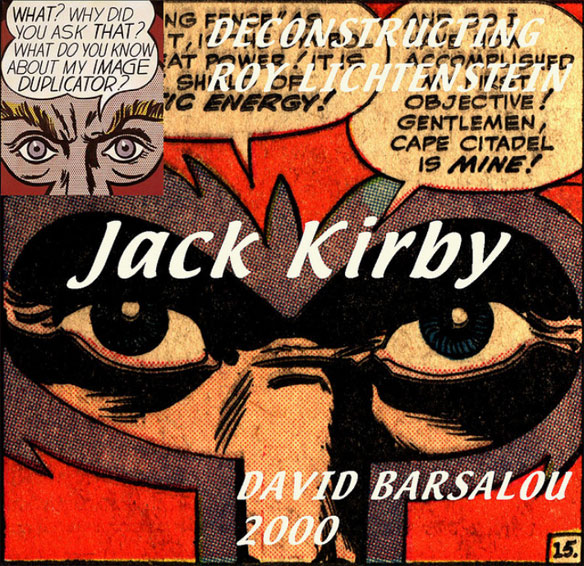
Yes, Lichtenstein even stole from Jack Kirby, the king of comics. No surprise really. Might as well steal from arguably the best, most prolific artists to ever work in comics, right? And hey, if you're going to steal from him, why not bastardize the image as much as possible.

And just in case you can't tell from the extreme close up, the original? That's the X-Men villain, Magneto. And I once again just have to point out how horrible that lettering is. My god. Just take the words out if you can't do it.

And here's a piece called "Reckon Not, Sir!". If you can't tell, Lichtenstein was a master of titling his work. And if you also can't tell, I'm heavily falling into sarcasm the more I do this. Apologies, but its the only way I can cope with it.

This one here isn't nearly as much a direct copy as others, but it still very clearly is a copy. And, again, a horrible attempt. The cowboy hat put on Lichtenstein's character? There's no way that's actually on his head. Hats don't work like that. That's least two different angles, possibly three. THIS is why I get angry. This kind of thing creates that pervasive talk that comic art is, and always has been, bad. That is CLEARLY not the case.

Joe Kubert, the artist of the original piece from DC Comic's Sgt. Rock, is one of the classic artists that has defined what American comics have looked like. That panel alone is gritty, hard, and filled with intense emotion. It is an amazing piece of art, and guess what? Its tiny. Because its a comic book panel. That takes an intense skill that few have.

And to go a little further, Joe Kubert is no slouch either. The man founded The Kubert School, a technically school entirely focused on teach sequential art and the craft of comics. There is a huge list of alumni from the school that have gone on to work in comics and become famous in their own right, including his two sons, both of whom work in comics today.

This is the last image I'm going to attack for this post, and there's a specific reason for it. Lichtenstein called this "Seductive Girl", and as you can see from both of his versions, the title is in every way a lie. The life and emotion in this image only came from Mike Sekowsky, as all of that is gone in Lichtenstein's.

And yet, how many that read this know Mike Sekowsky? He worked on so many comics its almost crazy. From superheros like the Justice League of America and Wonder Woman to romance comics, westerns, and war comics. But we see the image there in the bottom right hand corner, those bright, garish colors and the flatness of it all, and we think that's him. We think that because Lichtenstein has helped to paint the image of American comics as low quality art, but the larger image, Sekwosky's actual art, is never seen.

Yes, I'm not the first to rant and rave on this. No, I won't be the last. And I shouldn't be. There is no justification for putting Lichtenstein in a museum when these artist and tons of others have been treated like trash by the art community, first, and then the public at large, second. We give credit to a hack like Lichtenstein and happily claim how good he is compared to those bad old comics, but most people never look at those originals.

Every single art student should. Especially American art students. Why? Its our history. American comics are a truly American style, and there are great, amazing artists that helped to define it and are still changing it today. That's why this blog exists, because I want other artists to know about them. I want teachers to see them and show their students. And I want hacks like Lichtenstein treated like they deserve to be: Liars and thieves.

Next update...I'll go back to talking about artists I love that we should all love. But this needed to get out.

Friday, June 24, 2011

On Captain America

With the live action movie starring Chris Evans coming this Friday, I feel like now is about the best time to put down some thoughts in regards to Captain America. The prompting of this is fairly simple. I feel like many people see the costume and hear the name and judge the character without any other thoughts. This is, of course, unfair to any character of any medium, but as I was once guilty of this with Cap, specifically, I wanted to put down why this has changed for me and why I think it should for others.

So basically, the reasoning is very similar to my general talks on comic art and the medium: Why does it mean and why does it matter?

The best place to start is, of course, at the beginning. Captain America was created by Joe Simon and Jack Kirby in 1941, part of Timely Comics, the company that would eventually become Marvel Comics. The basics of the character are pretty simple. A young, weak, skinny kid named Steve Rogers wants to fight in WWII like everyone else his age, but isn't allowed to sign up due to being so weak and small. Instead, he is given the chance to take part in a top secret project, Operation: Rebirth, with the goal of creating the perfect soldier. Rogers is selected as the first test subject, and it succeeds, transforming him into the a strong, perfect human specimen, but the project is sabotaged leaving him the only Super Soldier created by the project.

From there, Cap goes to fight in WWII. He servers as a symbol to the troops and fights Nazi super soldiers and mad scientists during the war, until being presumably killed in action attempting to stop an experimental plane late in the war. In fact, Cap is not killed, but falls into the ocean and is frozen in the ice until being found in the 1960s, then joining the newly-formed Avengers with Iron Man, The Hulk, Wasp, Giant Man, and Thor, and that's when the more typical super hero things begin.

Since then, the usual insanity of a 50 years of publishing serialized stories has occurred, with Cap having done everything from fighting aliens in space, giving up the mantle of Captain America, and even the requisite super hero death and return.

There have even been others to take up the Captain America name, most recently his former sidekick Bucky, but the fact remains that Steve Rogers will always be the Captain America we think of the most. Any detours from this path tend to be temporary and mainly to explore other aspects of the character.

And that, right there, is what I want to get into. The character of Steve Rogers.

It is extremely easy to dismiss Captain America as a jingoistic, overly-patriotic anachronism. Hell, his costume is pretty much the American flag. But that is very much judging a book by its cover. While draped in those colors, the real focus is not on patriotism or some nationalistic push, but instead what it is to be good. Steve Rogers, at his core, is a good man. He does what is right because it is right, not for some political ideal. Cap is, or at least should be, above politics and nationalism.

He is the American ideal, yes, but he's also more than that. He is a human ideal, and not just physically. In many ways, he is comparable to Superman. They are the pinnacles of good in their respective universes, the role models that everyone looks up to, and the ones that never flinch in the face of evil. They are, put simply, true heroes. But while there are countless similarities, a key difference that truly defines Captain America remains.

Superman is an alien. He is from another planet, has powers we can only dream of, and is simply not human despite how close he may seem. Captain America is human. He has all of our faults, yet through it all is able to remain good. His powers are super human, yes, but to a degree that one could argue is attainable more than things like flight or heat vision or anything like that. Captain America is us. He is an ideal that is within reach for the common man in some way.

That is because the essence of what makes Captain America what he is does not come from the super strength or the costume or the title. The essence of it all is Steve Rogers. The kid from Brooklyn that always had the strong convictions and good heart that made him the hero he became. He may have been a scrawny kid, but his true strength comes from his desire to do good. And even with all the powers, that is who Steve Rogers has remained. That is why no one can really replace him as Captain America.

And that is why Captain America matters.

He may fight Nazis, aliens, super soldiers, mad scientists, and a few random criminals, but he is what we should all attempt to be in the end: A good man.