Showing posts with label comparison. Show all posts

Friday, August 12, 2011

Roy Lichtenstein: Plagiarist or Art Thief?

Okay. Before this gets going, two warnings. First: this is likely to be a very long entry. I may even divide it up into two posts. So get comfy. Second: This will, most likely, be my only negative talk about an artist. This is a topic that makes me very angry. In fact, my anger over this topic is part of the reason this blog exists in the first place. There is a distinct possibility I will be much less formal and devolve into angry ranting. I shall do my best to avoid this, but you've been warned. This is something I'm very passionate about.

So. Roy Lichtenstein. His art is loved by artists, teachers, critics, historians, and students alike. Everyone knows "his" work, and those quotes are there for a reason as can likely be inferred from the title of this post alone. Every single art history class mentions him in some form, be it at a high school or college level. He is supposedly a great master of Pop Art, one of the first, even. His taking of comic panels and turning them into larger paintings is still seen as a great use of "low art" and turning it into "high art."

To that, I give you a simple response that can sum up my entire feelings on this without any pretense.

Bull. Shit.

First, it must be made clear that my anger towards Lichtenstein is not because I'm some crazed lover of comics. Clearly, I love comics. Clearly, I believe comics should be treated as art and not some trash to be ignored. And guess what? Lichtenstein is the poster child for the problem. His copies of panels from master comic artists are insipid pieces that only have any life because of the original artists, not his work. Not to mention the fact that nearly all of his copies are inferior to the originals on basic levels, such as line quality, form, etc. And on top of THAT, his lettering is offensively bad all on its own. Oh, and on top of even that, there's the fact that he never credited the original artists, selling his copies for millions while the actual artists saw nothing of it and some spent their lives struggling to make it.

Now before I get into direct comparisons between his "art" and the original works, I want to shoot down the usual counters to these points I'm making. I've already hit on the fact that comics are not "low art" and that the artists behind the originals are worthy of far more praise than they ever have received from the art community, but just keep repeating that because its going in circles in my head.

The other major thing is the idea of Pop Art. One of the other major players in the Pop Art movement was Andy Warhol. Everyone knows his work to some degree. Soup cans, Marilyn Monroe, etc. He stole, too, and while I have a special hatred for some of his work for similar reasons, Lichtenstein was specifically stealing from OTHER artists at the time and essentially taking credit for their work, all the while letting the art world continue to belittle them. But on the idea of Pop Art, the twisting of popular culture into "art" and playing on ideas of mass production and similar themes, Lichtenstein's work STILL doesn't qualify as worthy of praise. Why? Because it is simple plagiarism, at best, and theft, at its worst. Many of the artist he copied were working at the time he was.

This is where the "but all artists steal" comment always comes in. And yes, in many ways, that's true. But that doesn't mean we should condone it, or dismiss the original artists as mere "drawers" as the Lichtenstein Foundation has. But you also have to remember that the only reason Lichtenstein is continued to be seen as such a great artist and thus, can get away with it even after his death, is because he has "historical significance." That's a pathetic way of saying that, yet again, he's better than the original artists despite the fact that doing what he did in any Art School worth its salt would have a student dismissed. You don't get to steal hundreds of pieces of art from other artists and call it your own, especially if you refuse to admit they existed or did anything of significance before you came along and did your thing. That's just called being an asshole.

So suck it up and accept the truth. Lichtenstein was a hack that couldn't paint well even when he copied, and now's the part where I start posting images to show that.

But yet again, one more thing crops up that I must mention. The images I'll be using are from an man named David Barsalou, who's been working for over three decades to find the original sources of many of Lichtenstein's paintings. He has an amazing Flickr page with tons and tons of these, with bits and pieces of info attached to the images and well worth looking through. I'm only going to highlight a few.


So right there is one of Lichtenstein's most famous pieces. He called it "WHAAM!" because of...well, obviously, the sound effect. The original is the top piece, and its from All-American Men at War #89, drawn by a man named Russ Heath. Looking at both side by side, sort of, it should be strikingly obvious which one is a copy and which one is an actual piece of art. Lichtenstein's copy of it is stunted, and badly rendered, despite the fact that he projected the images larger and TRACED them. There is no life to his copy, where as Heath's screams movement and force, emphasized as much be the missile as by a more strongly created and placed sound effect.

And make sure to look at Lichtenstein's attempt at lettering. Not only does he place the caption box in such a way that it looks like a damned flag on the tail of the plane, but his construction of the letters alone is simple sloppy and bad.


Here's another of Lichtenstein's famous pieces, he called it "Drowning Girl." This is, in fact, and obvious if you can read basic English on that image above, actually by an artist named Tony Abruzzo. It is likely from DC's first romance book that started in 1949, called Girls' Love Stories, a title that featured art by many of the great names in comic art.

So what makes Lichtenstien's version of it, the smaller one, art? Nothing. Nothing that wouldn't invalidate them both. All that he did to change it was his usual bad lettering, removing a line of the dialogue, and cropping it just a bit more. So why does Lichtenstein get credit for this and not Abruzzo? Hell, I'll admit, I didn't even know Abruzzo until I hunted information on him, and that is a DAMN shame.
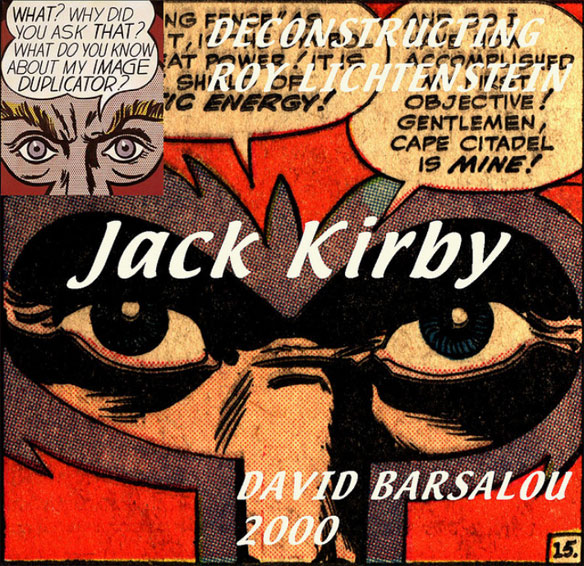

Yes, Lichtenstein even stole from Jack Kirby, the king of comics. No surprise really. Might as well steal from arguably the best, most prolific artists to ever work in comics, right? And hey, if you're going to steal from him, why not bastardize the image as much as possible.

And just in case you can't tell from the extreme close up, the original? That's the X-Men villain, Magneto. And I once again just have to point out how horrible that lettering is. My god. Just take the words out if you can't do it.

And here's a piece called "Reckon Not, Sir!". If you can't tell, Lichtenstein was a master of titling his work. And if you also can't tell, I'm heavily falling into sarcasm the more I do this. Apologies, but its the only way I can cope with it.

This one here isn't nearly as much a direct copy as others, but it still very clearly is a copy. And, again, a horrible attempt. The cowboy hat put on Lichtenstein's character? There's no way that's actually on his head. Hats don't work like that. That's least two different angles, possibly three. THIS is why I get angry. This kind of thing creates that pervasive talk that comic art is, and always has been, bad. That is CLEARLY not the case.

Joe Kubert, the artist of the original piece from DC Comic's Sgt. Rock, is one of the classic artists that has defined what American comics have looked like. That panel alone is gritty, hard, and filled with intense emotion. It is an amazing piece of art, and guess what? Its tiny. Because its a comic book panel. That takes an intense skill that few have.

And to go a little further, Joe Kubert is no slouch either. The man founded The Kubert School, a technically school entirely focused on teach sequential art and the craft of comics. There is a huge list of alumni from the school that have gone on to work in comics and become famous in their own right, including his two sons, both of whom work in comics today.

This is the last image I'm going to attack for this post, and there's a specific reason for it. Lichtenstein called this "Seductive Girl", and as you can see from both of his versions, the title is in every way a lie. The life and emotion in this image only came from Mike Sekowsky, as all of that is gone in Lichtenstein's.

And yet, how many that read this know Mike Sekowsky? He worked on so many comics its almost crazy. From superheros like the Justice League of America and Wonder Woman to romance comics, westerns, and war comics. But we see the image there in the bottom right hand corner, those bright, garish colors and the flatness of it all, and we think that's him. We think that because Lichtenstein has helped to paint the image of American comics as low quality art, but the larger image, Sekwosky's actual art, is never seen.

Yes, I'm not the first to rant and rave on this. No, I won't be the last. And I shouldn't be. There is no justification for putting Lichtenstein in a museum when these artist and tons of others have been treated like trash by the art community, first, and then the public at large, second. We give credit to a hack like Lichtenstein and happily claim how good he is compared to those bad old comics, but most people never look at those originals.

Every single art student should. Especially American art students. Why? Its our history. American comics are a truly American style, and there are great, amazing artists that helped to define it and are still changing it today. That's why this blog exists, because I want other artists to know about them. I want teachers to see them and show their students. And I want hacks like Lichtenstein treated like they deserve to be: Liars and thieves.

Next update...I'll go back to talking about artists I love that we should all love. But this needed to get out.

Wednesday, June 8, 2011

Art and Comics

Okay. I've made an introduction, then given a light overview of comics as a whole from my view. Now it's time to get in depth. I've been told by more than one person that I don't ramble here as much as I worry about, so shame is going out the window and this is going to dive straight into it.

It's time for me to hit on a point that, to me, has been one of the largest barriers against comics: The art world. It should be said that, for those that don't know, I graduated from Flagler College's Fine Art program back in 2009, and along with the making of art (and the varying levels of success that comes with when you still haven't figured out what you want to DO with your art) I also spent a lot of time studying History and Art History. I love it. I eat that stuff up. But as I found myself drifting to the world of comics, I ran into a very large problem. In that world, comics are 'low art' at best, and completely ignored at worst.


So what I want to get into here is what I wish I'd had time to get into back then. This is a long diatribe that I firmly believe every single art student and teacher and working artist should hear and absorb, whether they like it or not. Because, as I've touched on before, comics matter. Comics are more than just superheroes and spandex and those terrible sound effects most people think of thanks to the old Adam West Batman show. In fact, those things aren't really comics at all, especially not today.

In that vein, the first thing to do before continuing to read all of this mess is understanding what I mean when I say 'comics'. A good replacement for that is 'sequential art', a term from the wonderful Wil Eisner, but you can go even simpler than that. Not all comics are a sequence of panels to tell a story. Some are just in one panel. A story in a single image. In many ways, that is the same thing that a comic is. Visual storytelling. Cave paintings used multiple images to do this, and many of the painters we think of when we think of so-called 'High Art' only needed the one image. But the best always tell a story, except when they don't, but that's getting into an area of art this isn't concerned with.


We'll start by looking at one my favorite paintings, and a prime example of storytelling in a single 'panel'. This is The Raft of the Medusa by Theodore Gericault, and you should really click the image to see it larger. I'm not going to get into a strong analysis of the painting itself, as that has been handled by actual scholars much better than I ever could. But for my purpose, here's what's important: We have a single image that tells a complete story even if you don't know the even it is depicting. A group of men are on a poorly constructed raft, clearly suffering and some dying, while some wave to a tiny spec of a ship in the distance in hopes of rescue. That is a huge over simplification of the actual subject matter, but it's what one sees in front of them without anything else to assist. Looking further, a story can be seen. Some disaster can be easily inferred, considering that usually we don't sail the seas in those numbers on such a craft, as can many other small details. The important point here is this, though: It tells a story. In one image, there is an entire story for the viewer to find.

For this, I'm going to use something that might be surprising as a comparison. No, I'm not pulling out a beautiful Jack Kirby page or something else that might be expected. Instead, I'm going to use something much, much more modern. This is from S.H.I.E.L.D., the very first issue, that came out back in 2010, and just like above, you need to click this image to appreciate it. Unlike the above painting, this is a modern comic (clearly), and thus not just one artist is credited. The lineart that form the base of the image are by Dustin Weaver and the color is by Christina Strain.


So, why this image? For the purposes of this article, this page from S.H.I.E.L.D. is very similar to The Raft of the Medusa. Rather than use a comic page of multiple panels, I chose to compare a single image to another, both of which can tell a compelling story on their own. Though, obviously, this comic page has some story leading into it, it is ultimately not all that necessary to the point I'm trying to make. And the point is, finally, this:

What is so different between these two works of art?

Beyond the obvious differences such as the artist, material, and when it was made, shockingly little. So why does this page not count as art in the same way? Is it the giant, purple man in the distance or the glowing guy flying over 1580s Rome? Is it truly the material? Are oil paints just better and more 'artistic', in the end? Is it simply a case of attributing greatness to something that is old just because of it's age?

In some ways, all of those are at least partially accurate, but also reveal a striking double standard that we apply to the word 'art' and what counts as 'low' and 'high' art.

NO, the presence of a giant, purple and blue-clad man and a flying, glowing humanoid are not enough to discount this as art or worthy of praise. Many paintings and sculptures of divine beings and Classical Gods are just as ridiculous from an academic standpoint. Even the strange machine in the foreground is not enough to damn this piece on content alone.

Despite what many older artistic traditions would teach us, oil paints are not inherently superior. They are difficult to work with, have amazing possibilities once learned, and some of the greatest works of art of all time use them, but that does not make art that uses them better. To claim the material is better than a pencil or a computer or anything else used today would be like claiming that an older piece of literature is stronger than newer stories or books simply due to being handwritten.

How about age? Is that the true factor here? Do we only love many older pieces of work because they are older? In some cases? Probably. As a species, we have a habit of attributing the past with being better than the now, in almost every aspect of our society. This idea is patently ridiculous, and a moment's thought from anyone can prove this. Some people in the art world look down on comics due to multiple artists (pencilers, inkers, colorists) working on them, ignoring the fact that many of the old masters had entire studios assisting in their great paintings that were revere today.

But no, in this case, it is unfair to say that it's age is why The Raft of the Medusa is considered a great work of art. It simply is. There are a thousand reasons why, some insanely technical in regards to art theory and others as simple as how well the paint is handled and the emotion portrayed on the faces of the men on the raft itself. But this page of art from S.H.I.E.L.D. is not lacking in great technical skill, either. Rome of the 1500s is detailed beautifully, with an excellent use of perspective and scale. The detail is in the scope of the page, and it truly is a beautiful page that can be stared at for as long as any painting just finding new things to enjoy.

Just as with The Raft of the Medusa, this page presents a story we are only partially allowed to see. We can infer just as much and speculate in as many wild directions as we wish, and yet this is just a single double-page spread from the comic. But here is something where the comic page suddenly has a clear advantage. It is just a page.

For The Raft of the Medusa, we have but one image in one moment in the story that is being shown. With only the image, we can only speculate as to what could have happened to force those men onto that raft. Are they about to be rescued? We can't know. All we can know is they see something on the horizon, and clearly hope they will be. To learn more, that a shipwreck forced these men onto a hastily constructed raft and only 15 of the 147 men that crewed the ship survived, we must turn to a history book or some other source. In its time, this would have been common knowledge, yet still one would have to turn to another source. The image tells us none of this.

But for this comic page? Now we have the point where comics clearly find an advantage over so-called 'High Art'. This page is has pages before and after it. In page immediately before, we see that this is Rome in 1582, in the workshop of Galileo. This strange machine we see in the foreground was constructed by him, and upon turning the page, we learn why he built such a thing. Clearly, this machine has been built by Galileo to fight back this giant man that. I purposefully used a version of this page without text, as to more easily directly compare the two images, but this is another bit of information where we learn more of what will happen after without another source. Though there is no second page after this, the story moves on, Galileo narrates and tells us that this encounter with the giant is not, as he puts it "...how the world ends."

So why, then, is a comic page with such strong artistic aspects not good enough for most of the art world? It's a very simple thing: Elitism. The one great theme in Art History is the rejection of what is different to the so-called 'Art World'. Time and time again, critics and artists alike have declared what is and isn't art, and always history rolls over them and proves them wrong. In many ways, this is happening now with sequential art. There is a slow acceptance occurring in some sections of the art world, but it is still very small.

As I experienced first hand, even those my age see a comic and roll their eyes, expecting what they consider 'bad art' or something not worthy of their attention, all the while putting together pieces of art that are far more ridiculous. There are many that teach art that share this same problem, and that's why I do this.

I rant and I ramble and I continue on in circles over and over to say to those teachers: Comics are art. Comics are good art. And whether you believe it or not, you already accept many piece of art that are just single-panel comics.

Any good artist knows that art happens everywhere, you just have to look. So here I am, starting my crusade to make it easier for those that wouldn't look so hard. Because like I just said and will continue to say for the course of this blog, and likely the rest of my life...

Comics are art.